Quick answer: US retailers reach Japanese stationery suppliers through four routes: a US-based importer that already carries Japanese brands; a direct wholesale account with a Japanese maker; a Japanese trade fair such as ISOT or the Tokyo International Gift Show; or a B2B marketplace or buyer portal that opens accounts with many Japanese suppliers at once. The first is fastest to start and the most crowded, because every other retailer can buy the same names from it. Direct accounts and portals are how you reach the smaller paper mills, tape makers, and regional workshops that make a shelf worth walking to. On any route into Japan you are the importer, so US duties and freight belong in your model from the first order.
Key takeaways
- Four practical routes reach Japanese stationery suppliers: US-based importers, direct maker accounts, Japanese trade fairs, and B2B marketplaces or buyer portals. They differ in how much of the import work stays with you.
- The famous names are the easy part. Pentel, KOKUYO and Zebra have distribution, so a shelf built only from them reads as competent rather than distinctive.
- Breadth across small makers is what turns a section into a reason to visit, and it is the part the easy routes do not solve.
- Stationery is consumable, so reorderability is a buying criterion equal to margin. An anchor item you cannot restock for years is not an anchor.
- Duty is assessed on value, not weight, so it matters even on light goods. Buy from a US importer and it sits inside your price; buy from Japan and you owe it yourself.
Where to find Japanese stationery wholesale suppliers
Four routes carry almost all of the Japanese stationery that reaches US shelves, and most buyers who run a serious section use more than one: one for the dependable everyday lines, another for the pieces nobody else has.
US-based importers and distributors. A number of American companies carry the widely distributed Japanese brands and sell to retailers on ordinary domestic terms: you write a purchase order in dollars, the goods leave a US warehouse, and no part of the import work is yours. It is the fastest way to open a section. It is also the same catalog every other retailer in your city can buy from.
Direct wholesale accounts with Japanese makers. Most established makers run a wholesale channel and will consider an overseas retailer. The account gets you closest to the maker, which is where the pricing and the exclusivity both sit. What you take on is real: correspondence, terms, and catalogs are written for the domestic market, so you are stepping into a process designed for someone else, and export documents, freight booking, and customs entry all become yours. Our guide to vetting Japanese suppliers covers what to check first.
Japanese trade fairs. ISOT, the International Stationery & Office Products Fair, runs at Tokyo Big Sight as part of LIFESTYLE Week, organized by RX Japan; its visitor profile is explicitly importers, distributors, wholesalers, and retail buyers, and the next edition runs June 9–11, 2027. (ISOT official page) The broader Tokyo International Gift Show also runs a large stationery and paper-goods presence. Walking a fair is one of the few ways to meet makers who never appear in an English catalog, at the cost of travel and everything after the handshake.
B2B marketplaces and buyer portals. These open one account that reaches many suppliers, so adding a maker to your order is a search rather than a new negotiation. Range varies enormously, from a handful of export-ready brands to a broad slice of the Japanese domestic market, so the question to ask is how deep the Japanese supply goes rather than how many suppliers are listed. We compared the online options in where to buy Japanese products wholesale online.
| Route | How you buy | What stays with you | Where it fits |
|---|---|---|---|
| US-based importer or distributor | Purchase order in dollars against US-held stock | Ordinary domestic receiving, nothing more | Opening a section fast, and refilling between direct orders |
| Direct account with a Japanese maker | You apply to the maker, agree terms, and order from Japan | Export documents, freight, customs entry, duties | One or two makers you intend to build a long relationship with |
| Japanese trade fair (ISOT, Tokyo International Gift Show) | Meet on the show floor, open accounts afterwards | Travel, the show calendar, and all logistics after the meeting | Finding makers who never appear in an English catalog |
| B2B marketplace or buyer portal | One account across many suppliers, one cart | Duties and clearance in your country | Breadth across many small makers without a project per maker |
The category-independent version of this comparison is in our complete guide to sourcing Japanese products wholesale in the US.
Six named examples for the four routes, and what their own pages say
Routes are abstract until you have a name to type into a browser. The third-party examples below are companies whose public pages we read in September 2026; two of the four routes get two examples because they come in distinct variants. They are here as illustrations of what each route looks like in practice, not as recommendations. Terms change, so read the page before you plan an order around it.
| Route | Example | What its own page states | First step |
|---|---|---|---|
| US-based importer or distributor | Clever Idiots | Runs a wholesale catalog of Japanese desk and stationery goods for retailers; its wholesale policies state a $300 minimum order and $250 minimum reorder per delivery point, a resale or tax-exemption certificate before shipment, and goods shipped FOB Ontario, California | Submit its retailer wholesale application, then read the policies page before your first order |
| Direct account with a Japanese maker | KING JIM | Lists King Jim Co., Ltd. in Tokyo as the international contact and a US agent, BOUS Co. in Irvine, California, for retailers; also sells through Faire, where its storefront shows a $100 minimum | Email or use the contact form; if you already have a Faire account, search the brand there instead |
| Direct from Japan through an export wholesaler (a variant of the direct route: you are still the importer) | Champion Bungu | Japan-based, sells Pentel, Zebra, KOKUYO and Tombow lines, among others, to retailers and distributors worldwide; states that "the minimum order quantity (MOQ) is negotiable" and accepts international bank transfer and PayPal | Send an inquiry through its form; you are the importer, so duties and clearance are yours |
| B2B marketplace or buyer portal (US-based marketplace) | Faire | Has a Japanese-products section where stationery brands appear; buying terms are Faire's standard retailer terms, which we compared in Faire for Japanese brands vs. sourcing direct from Japan | Open a retailer account and search the section |
| Japanese trade fair | ISOT at Tokyo Big Sight | Visitor profile is importers, distributors, wholesalers and retail buyers; next edition June 9–11, 2027 | Register as a trade visitor, then open accounts after the show |
| B2B marketplace or buyer portal (Japan-side buyer portal) | orosy | One account across many Japanese suppliers, one cart, and orosy arranges international shipping to your country | Sign up at orosy and search the stationery categories |
Two patterns stand out in the table. First, the maker-direct route is not one thing: some makers have a US agent or a Faire storefront, which makes the account far easier to open than a cold email to a Japanese office, while many smaller makers have neither. Second, every route that ships from Japan leaves customs entry and duties with you, and every route that ships from a US warehouse has already priced them in. That is the trade you are choosing, not a difference in how helpful the supplier is.
Big names or small makers: how to split the buy
Japan's major writing-instrument makers are old, deep companies. Zebra dates to 1897, KOKUYO was founded in 1905, and Pentel, comparatively young, was founded in 1946. (JetPens — 100 Years of Japanese Stationery) Over those decades they refined products the global stationery community now treats as benchmarks: Pentel's markers and mechanical pencils, Zebra's gel rollerballs, Midori's flat-opening MD notebooks on its own house paper. (JetPens — Japanese Stationery) These are market facts about widely recognized brands, not a claim of exclusive or authorized representation by orosy.
Those names are also the easy part of the buy. They are large enough to have distribution, so a US-based importer carries a slice of them and you can start there with no operational work of your own. Every competing retailer starts there too, which is why a shelf built entirely from the well-distributed names is a capable pen aisle that looks like every other capable pen aisle.
What makes a shelf feel deep is the tail behind those names: smaller paper mills, regional makers, single-product workshops, the letterpress, washi, masking-tape and sticker makers whose output is sized for the Japanese market. Those catalogs were refined for domestic buyers over decades and were never built to face outward, which is why so little of it appears in English or in an ordering flow a US buyer can use. The catalogs exist; there is just no ordering path a US store can use on its own.
The tail matters more here than almost anywhere else, because breadth is the product. In ceramics, one exceptional line can carry a shelf. In stationery, forty small, good things beat four excellent ones, because the customer is browsing.
Minimums, units, and why the reorder decides everything
Stationery is consumable, and that single fact runs through every buying decision in the category. A gel pen is bought once and then bought again, or a refill is bought in its place. A notebook fills up and the customer returns for the same one, if you still carry it. Pencil lead, ink cartridges, sticky notes, and tape refills all behave the same way. The category's economics live in that second and third purchase, so the number that matters for an anchor item is not first-order sell-through but whether the customer can come back and find it.
Reorderability is a buying criterion, equal to margin. Before an item becomes an anchor, establish that you can restock it dependably, at a workable minimum, for as long as you intend to sell it. A product you can get once is a novelty item and belongs elsewhere in the plan. Stocking a customer favorite you then cannot replace is worse than never having carried it, because you trained the return visit and then broke it.
Carry the refill next to the thing it refills. This gets skipped constantly. A pen wall without refills is a display; a pen wall with refills is a supply cabinet, and customers treat it accordingly.
On minimums, there is no single figure anyone can give you: they are set per supplier and vary by maker, product, and route. What is structurally true is that pens, refills, and pocket notebooks are small, light, and inexpensive per unit, so first orders can usually be sized to a genuine test rather than a warehouse commitment. The vocabulary you will meet on a Japanese order form — order unit, lot, case pack — is unpacked in Japanese wholesale terms explained, and the way the price itself is expressed, as a percentage of the Japanese retail tag, is in how kakeritsu pricing works.
Plan the section in three tiers, not as one flat shelf
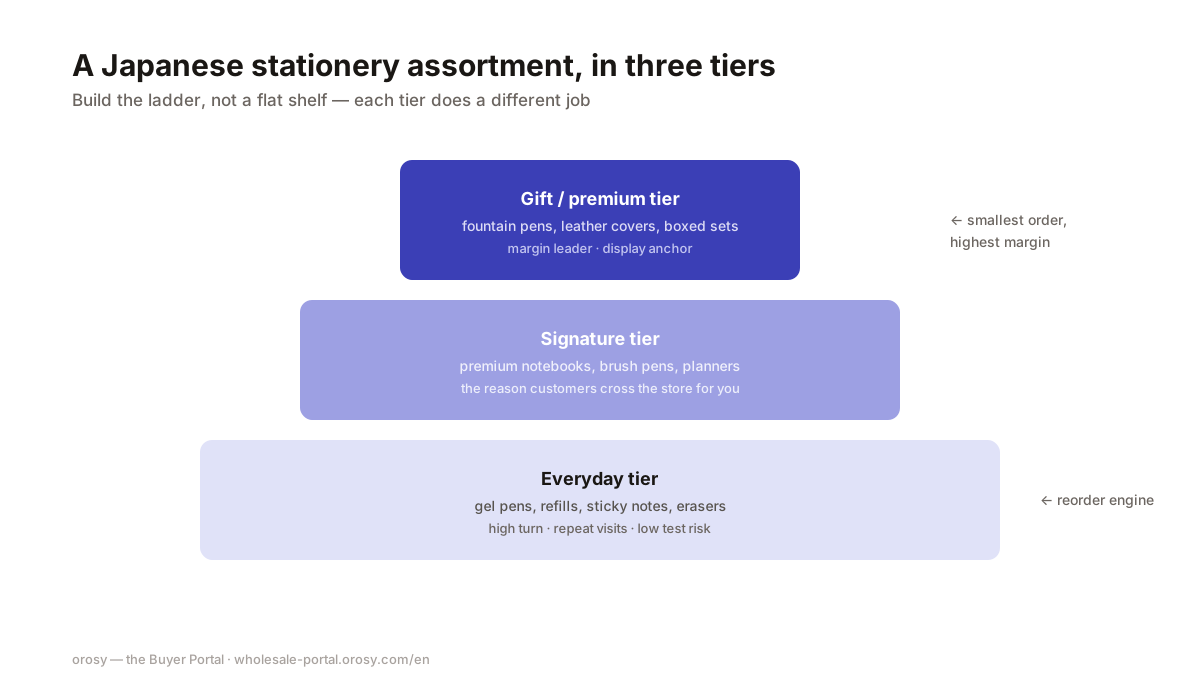
Build three tiers, not one flat shelf. Each tier does a different job.
The three tiers are not price bands with different markups. Each does a distinct job.
| Tier | Typical products | The job it does | Buying rhythm |
|---|---|---|---|
| Everyday | Gel pens, mechanical pencils, pocket notebooks, refills and leads | Brings the same customer back when the last one runs out | Steady reorder of a fixed item list |
| Signature | Design-forward notebooks, planners, fountain pens, letter sets | Decides whether the shelf reads as chosen rather than stocked | Reviewed each season, changed slowly |
| Gift | Boxed sets, premium pens, pieces that present well as they are | Carries the margin and the gifting weeks | Bought against the calendar, in bursts |
A section that skips the everyday tier looks impressive and sells once per customer; one that skips the signature tier never gets photographed. Spread across all three and the same square footage serves the quick add-on at the register, the deliberate personal purchase, and the present.
The release calendar is planned inventory, not impulse buying
Japanese stationery makers release constantly: seasonal colors, limited runs, collaborations with illustrators and other brands. A buyer arriving from furniture or homeware reads that cadence as instability. Here it is the engine. An anchor assortment gives a customer a reason to visit when they need something; only a changing one gives them a reason to visit when they do not.
Running the rotating slot well takes three decisions made in advance rather than at the end of an order. Fix its share of the section, in shelf space and in open-to-buy, and hold that line — left undefined, the slot gets raided whenever an anchor needs restocking. Buy it on the release calendar rather than on availability, because ordering once you notice competitors carrying something means arriving late into the part of the assortment whose whole value was being early. And let it expire: rotating stock is supposed to sell out and be marked down, and that markdown is a small cost against what the slot does for return visits.
Importing Japanese stationery into the US
If your goods come from Japan rather than a US warehouse, you are the importer, and two costs sit on top of the wholesale price.
Freight is the friendlier of the two. Stationery is small, light, and dense in value per box compared with ceramics or homeware, so freight is a smaller share of landed cost here than in ceramics or homeware, but it is still a line you model rather than one you ignore. Duty is the one that surprises people: it is assessed on declared value according to how your product classifies in the US Harmonized Tariff Schedule, and it applies regardless of how little the shipment weighs. Light goods do not get a light duty.
| Cost line | What determines it | When you see it |
|---|---|---|
| Wholesale price of the goods | The supplier, usually as a share of the Japanese retail price | At the time of the order |
| International freight | Weight, dimensions, and the service used | Arranged and billed separately from the goods |
| US import duty | Your product's classification in the Harmonized Tariff Schedule, applied to declared value | At entry, through your customs broker |
| Brokerage, handling, and inbound delivery | Your broker and your own receiving arrangements | On the brokerage and delivery invoices |
Buy from a US-based importer and all of this happened upstream: the duty was paid before the goods reached the warehouse and sits inside the price you are charged. Buy from Japan and each line is yours. Neither is cheaper by definition, which is why both belong in the same arithmetic. How the duty rate is built and how to look up your own classification is covered in our customs, duties, and logistics guide, and the full comparison method is in the landed-cost model for Japanese products.
Where orosy fits
Breadth is the specific problem orosy was built for, and stationery is where that matters most, because a shelf assembled from the well-distributed names is exactly the shelf a customer has already seen.
The name comes from the Japanese word orosu (卸す), "to wholesale." orosy connects buyers to a wide breadth of Japanese supply on one account, drawn from the 5,000+ Japanese brands and suppliers and about 200,000 products on its Japanese marketplace. The catalog available for shipping to the US is stationery (over 50,000 products), so stationery is the part of it a US store can order today, and brands that appear in it include Pentel, King Jim, Mind Wave, Kamio Japan, and Old Resta.
Here is how deep that gets, in the words a buyer would actually search for. Each figure is a keyword search run against the live catalog with the delivery country set to the US, on 2026-10-09. They are what a search returns, not tidy category totals, so a count includes anything whose name carries the word. What is listed changes over time, so treat the catalog itself as the answer to what you can buy on the day you order.
| Search term | Products for US delivery |
|---|---|
| シール (stickers) | 4,266 |
| ノート (notebooks) | 4,172 |
| マスキングテープ (masking tape) | 2,344 |
| ボールペン (ballpoint pens) | 1,648 |
| 付箋 (sticky notes) | 1,216 |
| レターセット (letter sets) | 979 |
| 万年筆 (fountain pens) | 761 |
| シャープペン (mechanical pencils) | 692 |
| Whole catalog for US delivery (measured 2026-10-09) | 56,607 |
The search terms are shown in Japanese because that is what was searched, but you can search in English as well: an English term is read across to Japanese search terms. Product names and descriptions still come back in Japanese, and not every English word finds a match, so a term that returns nothing is worth retrying in Japanese. Counts brand by brand, measured the same way, are in Japanese stationery and pen brands in wholesale.
orosy carries the negotiation and account opening with each supplier, so reaching a small maker is not a separate project, and a basket spanning several makers is one cart and one invoice. orosy arranges the international shipping to your country. You do not need a forwarder or a receiving point in Japan.
Be precise about which part of the work moves and which part stays with you. Before you order, the cart shows a reference figure for international shipping, for your information only. The actual shipping cost is calculated later and billed to you, and it can differ from that figure. Customs clearance in your country, import duties, and taxes at import are your responsibility. They are not part of the cost billed by orosy. Delivery to a receiving point inside Japan also remains available.
Shopify stores have a shorter way in. The orosy Wholesale app is free to install and runs the search, the cart and the ordering inside the Shopify admin, with no API key to issue. Products you pick become Shopify products carrying the title, brand, variants and barcode, with your markup on each variant, and stock you receive goes into Shopify inventory from the order page. The same wholesale terms apply, so order units and delivery-group minimums are checked in the cart before you order. The walkthrough is in sourcing Japanese wholesale inside the Shopify admin.
FAQ
How do I buy Japanese stationery wholesale from the USA?
Pick a route, open a business account on it, and confirm the minimum before you plan the shelf. The four routes are a US-based importer that already stocks Japanese brands, a direct wholesale account with a Japanese maker, a Japanese trade fair where you meet makers and open accounts afterwards, and a B2B marketplace or buyer portal that reaches many Japanese suppliers at once. Buying from a US importer works like any domestic purchase order. Buying from Japan means you are the importer of record, so US duties and freight belong in your cost model from the first order.
Where can I find Japanese stationery wholesale suppliers?
Four places, and most buyers use more than one. US-based importers and distributors carry a slice of the widely distributed Japanese brands. Japanese makers open direct wholesale accounts, though terms and catalogs are written for the domestic market. Trade fairs put you in front of makers in person, with ISOT at Tokyo Big Sight and the Tokyo International Gift Show as the two main ones. B2B marketplaces and buyer portals give you one account across many suppliers, which is the practical way to reach small makers.
What minimum order should I expect when starting with Japanese stationery?
There is no single figure: minimums are set by each supplier and vary by maker, product, and route. Stationery's small, low-cost units do make it easier to size a first order to a genuine test than heavier categories allow. Confirm the minimum with the supplier or platform before committing, and put the first order into anchor items you will want to reorder.
Do I pay import duties on stationery imported from Japan?
If you import the goods yourself, yes. Duty is assessed on declared value according to how the product classifies in the US Harmonized Tariff Schedule, and it applies no matter how light the shipment is. If you buy from a US-based importer instead, the duty was paid upstream and sits inside the price you are charged. Either way it belongs in your landed-cost model, because a low wholesale price and a low landed cost are not the same thing.
Is Japanese stationery a good category for a small retailer?
It is one of the easier Japanese categories to start with. The units are small, light, and low in cost per piece, so a first order can be sized to a real test rather than a warehouse commitment. It is also consumable: pens run out, notebooks fill up, and the customer comes back. The work is in merchandising it rather than in landing the first order.
Should I start with KOKUYO and the other big Japanese brands, or with small makers?
Start with the recognizable names to open the section, then build depth behind them. Pentel, KOKUYO, Zebra and their peers are old, large companies with real distribution, which is why a US importer can supply them and why every competing retailer can have the same wall. Depth comes from the smaller paper mills, tape and sticker makers, and single-product workshops whose catalogs were built for Japanese buyers. Those are harder to reach, and they are what makes a shelf worth a trip.
Sources
- JetPens — 100 Years of Japanese Stationery (brand histories: Zebra 1897, KOKUYO 1905, Pentel 1946): https://www.jetpens.com/blog/100-Years-of-Japanese-Stationery/pt/1016
- JetPens — Japanese Stationery (category overview, major brands): https://www.jetpens.com/Japanese-Stationery/ct/5690
- ISOT — International Stationery & Office Products Fair, official page (organizer, venue, visitor profile, June 9–11, 2027 dates): https://www.lifestyle-expo.jp/hub/en-gb/about/isot.html
- Clever Idiots — Desk & Stationery wholesale category: https://cleveridiots.com/c/wholesale/japanese-products/desk-stationery/
- Clever Idiots — Wholesale Policies ($300 minimum order and $250 minimum reorder per delivery point, resale or tax-exemption certificate, FOB Ontario, California): https://www.cleveridiots.com/wholesale-policies/
- KING JIM — Japanese Stationery Wholesale page (King Jim Co., Ltd. in Tokyo as international contact, US agent BOUS Co. in Irvine, California, Faire storefront showing a $100 minimum): https://kingjim.us/pages/wholesale
- Champion Bungu — Premium Japanese Stationery for Global Buyers (retailers and distributors worldwide, negotiable MOQ, bank transfer and PayPal): https://japan.championbungu.com/