Quick answer: Start with the records the Japanese government publishes. The National Tax Agency's Corporate Number Publication Site gives every registered company's 13-digit number, legal name and head-office address. Its qualified invoice issuer site shows whether a business is on the tax register as an invoice issuer, under a number written as "T" plus 13 digits. A dealer in used goods needs a permit from a prefectural public safety commission and, when selling online, must publish that permit number. Teikoku Databank and Tokyo Shoko Research sell rated credit reports. Then request a paid sample and size a small first order. The recurring problem is export-readiness, not legitimacy.
Key takeaways
- Four public checks cover most of it: the Corporate Number registry, the invoice registration number ("T" plus 13 digits), the legal disclosures page on the supplier's own site, and, for used goods, the secondhand dealer permit.
- None of the three is a quality signal: they prove identity and registration, nothing more.
- For real volume, Japan's credit-research agencies field-visit companies and rate them.
- The usual question isn't 'are they legitimate' but 'are they set up to export.'
- Paid samples and a deliberately small first order are normal steps.
Why vetting a Japanese supplier looks different
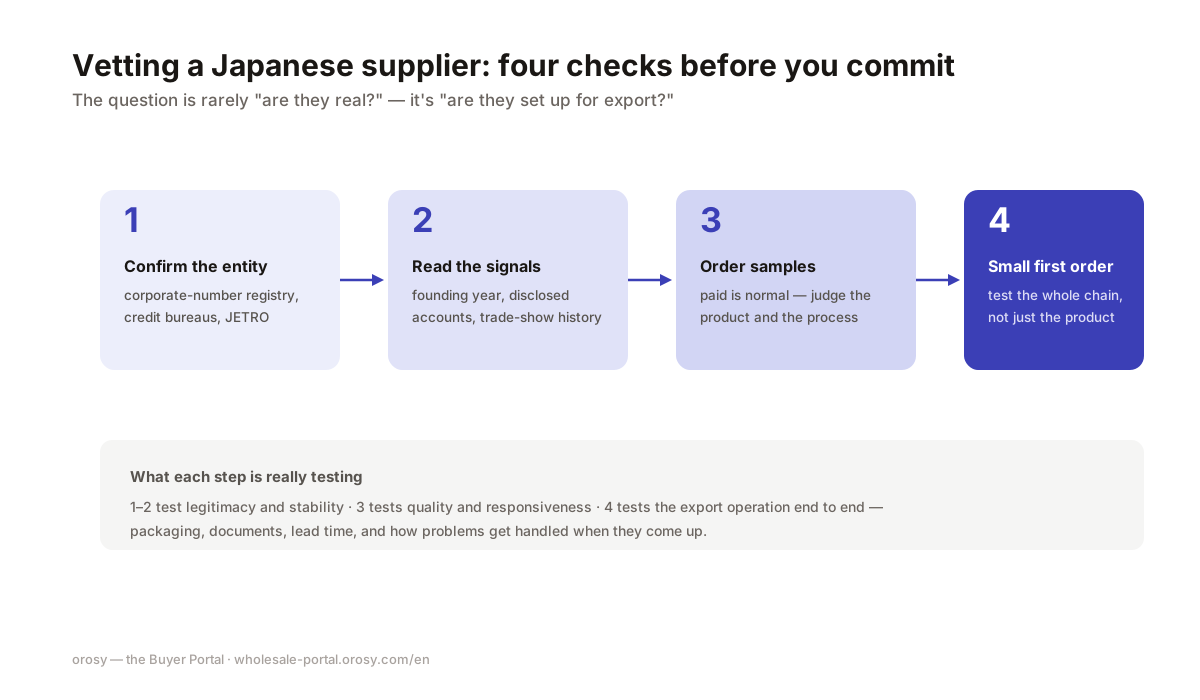
The figure's four stages: legitimacy first, then quality, then the export operation. They do not map one-to-one onto the numbered steps below.
A checklist built for other markets, where you assume the worst until proven otherwise, can lead you to misread Japan. Japanese B2B commerce runs on long-term trust, shaped by ideas like shinrai (trust) and giri (obligation), with partnerships formed through introductions rather than cold outreach. (KizunaX)
So fraud is not the default risk here: these are companies that have often sold to the same domestic accounts for decades. The friction you'll hit is that the maker has never sold abroad. The sharper question isn't "is this supplier legit?" but "is this supplier real, and are they set up to export?" The first has a fast, public answer; the second is a gap you can plan for.
Step 1: confirm the company legally exists
The Japanese National Tax Agency runs the Corporate Number Publication Site (法人番号公表サイト), where every registered organization is assigned a unique 13-digit Corporate Number. The number is designated automatically, and three data points are published for each: trade name, head-office address, and the number itself. (NTA) The site also publishes the history of any name or address changes, which is itself a signal worth reading. It has an English interface, the search is public and takes no account, and you can search by name, address, or number. (NTA Corporate Number Publication Site)
The English search only returns companies that registered details in English, so a "no result" may just mean you need the Japanese name. And this confirms registered identity, not financial health.
Still part of Step 1: three more public records, the invoice registration, the secondhand dealer permit, and the legal disclosures page
The Corporate Number tells you an entity exists. Three other public records say more, and none of them needs the supplier's cooperation.
The invoice registration number ("T" plus 13 digits)
Japan's consumption tax runs on a qualified invoice system. A business that wants to issue invoices its customers can use for input tax credit registers with the tax office and is notified of a registration number. The National Tax Agency describes the structure plainly: for a taxable business with a Corporate Number, the registration number is "T" followed by that 13-digit Corporate Number; for sole proprietors and others it is "T" plus a separate 13 digits. (NTA, what a registration number is)
The register is public: the tax agency runs a search site, open to anyone without an account, where you type the 13 digits and get the record back. (NTA qualified invoice issuer site) The published fields are the registered name and number, the registration date, any cancellation or expiry date, and, for a corporation, the head-office address. (NTA)
Why it matters:
- It confirms the business is on the tax register as an invoice issuer, under a name and address you can compare with what you were told.
- Because a corporation's number is "T" plus its Corporate Number, the two lookups cross-check each other.
- It is not a quality or export-readiness signal, and a smaller maker may have no reason to register.
The secondhand dealer permit (古物商許可)
This matters if you buy vintage, pre-owned, or collectible goods. Japan's Secondhand Articles Dealer Act requires a person who intends to operate a secondhand goods business to receive a permit from a prefectural public safety commission, acting through the prefectural police. (Secondhand Articles Dealer Act, Article 3, Ministry of Justice bilingual text)
What lets you verify from a distance is the display duty. Article 12 requires dealers to post a standard sign at each place of business, and a dealer selling over the internet has to make its name, the name of the commission that granted the permit, and the permit number viewable online. The Tokyo Metropolitan Police page on the amended Act sets out that duty, and notes that internet dealers publish those items even where a small-business exemption would otherwise apply. (Tokyo Metropolitan Police)
It's a two-sided check you can run in one email: ask for the permit number and the issuing commission, then look for the same items on the supplier's site. If none of it appears on an online storefront, that's worth a question rather than an accusation. Whether a permit applies to a given arrangement is a legal question for your advisor.
The disclosures a Japanese online seller publishes by law
Japanese sites that sell online carry a page usually headed 特定商取引法に基づく表記, "disclosures based on the Act on Specified Commercial Transactions." It's a required advertising disclosure, not marketing copy, and often the fastest way to confirm who you are dealing with.
The Consumer Affairs Agency lists what a mail-order advertisement has to show: selling price, shipping charges, payment and delivery timing, cancellation terms, and the business's name, address and phone number. Where the seller is a corporation advertising by electronic means, the name of its representative or of the person responsible for its mail-order business also has to appear. (Consumer Affairs Agency)
The labels are formulaic, so machine translation handles them, and the name, address and phone number give you the exact legal name and address to run through the Corporate Number search in Step 1. Note the scope: the duty attaches to mail-order selling, so a wholesale-only maker may not publish it.
What each check proves, and what it does not
| Identifier | What it proves | Where to check | What it does not prove |
|---|---|---|---|
| Corporate Number (法人番号) | The organization is registered, under a legal name and head-office address | NTA Corporate Number site | Finances, quality, ability to export |
| Invoice registration number ("T" + 13 digits) | The business is on the tax register as a qualified invoice issuer | NTA invoice issuer site | Not a quality mark; absence is no red flag for a small maker |
| Secondhand dealer permit (古物商許可) | The dealer holds a prefectural public safety commission permit for used goods | The supplier's site, where an internet dealer must show name, issuing commission and permit number (Tokyo Metropolitan Police) | Authenticity or condition of any item |
| 特定商取引法 disclosures | Name, address, phone and, for a corporation advertising electronically, a responsible person | The supplier's site (Consumer Affairs Agency) | Applies to mail-order selling, so a wholesale-only maker may not publish it |
None of these is due diligence on its own, but together they take you from "a website exists" to "a named legal entity, registered with the tax authority."
Step 2: go deeper with a credit-research agency
For a supplier you're about to commit real volume to, you want a read on financial health and history. Japanese businesses call these the "big two":
- Teikoku Databank (TDB), founded in 1900, publishes credit reports with a TDB rating that works as a widely recognized standard in Japan. It has long kept a "visit and confirm" practice, with field researchers physically visiting companies. (Teikoku Databank)
- Tokyo Shoko Research (TSR) is widely used for credit risk and due-diligence work, with particular depth on small and mid-size companies. (comparison of the two)
Either report gives a company profile, financials where available, and a credit rating. For a first small order that's overkill; for an ongoing commitment it's what Japanese companies use.
Step 3: use JETRO as a public, neutral resource
JETRO (the Japan External Trade Organization) is a government-related body that promotes trade between Japan and other countries, in both directions. It arranges meetings between Japanese companies and international buyers, runs business-matching platforms, and offers consultations on trade practices and regulatory questions from roughly 70 overseas offices. For a first-time buyer it works less as a verification database and more as a neutral party you can ask "is this normal?" (JETRO, JETRO USA)
How to read Japanese trust signals
Founding year. Longevity carries weight in Japan, where many makers and wholesalers are multi-decade businesses. A founding date stretching back decades reflects a company built on repeat domestic relationships.
Disclosed relationships. Japanese companies often publish their principal clients, banks, and affiliations. That openness is a deliberate trust signal, inviting you to check their reputation through known names.
Trade-show history. A record of exhibiting at established gift, lifestyle, or food fairs says a company invests in being found. (B2B trade-show etiquette in Japan)
One reframe saves first-time buyers the most grief. When something feels "off," such as slow replies, a Japanese-only site, or no export paperwork, the explanation is far more often export-inexperience than risk, and a maker that spent decades selling to domestic accounts has had no reason to build an English sales motion.
Requesting samples and designing a small first order
Samples
Expect to pay for samples. A nominal charge covering production and shipping is normal, particularly for finished or specialized goods, and reputable suppliers often credit that cost against a later bulk order. (Wise) Three norms to plan around:
- You typically cover sample shipping, including freight.
- Lead times run long. Sample and production timelines in the 30–90 day range are common, and peak seasons stretch them further. (Wise)
- Inquire from a verifiable business email. Japanese wholesale is strictly B2B, so suppliers generally won't sell to individuals without a business identity. (Ichiba.net)
A deliberately small first order
Your first order is a test: it has to validate that the product matches the sample, that the supplier can fulfill an export order, and that the relationship works.
- Confirm the minimum, then start at it. Minimum order quantities are set for the Japanese domestic market, so they can run higher than a foreign buyer wants for a first test. Ask directly, and start at the floor.
- Pin down Incoterms and who clears customs. Agree explicitly on terms (EXW, FOB, DDP) so it's unambiguous who arranges freight and who is responsible for clearance and duties. Our guide to Japanese wholesale terms covers the vocabulary a Japanese counterpart will use. This is the most common source of first-order surprises.
- Build a full landed-cost view. Add product cost, freight, and import duties into one figure before you decide; our walkthrough of importing Japanese products, customs and duties sets out the pieces.
- Agree on lead time and a reorder path in writing, and ask what a repeat order looks like.
A clean first order also proves that you are a reliable counterpart, which in a relationship-driven market is what earns better terms.
Handling the language gap, practically
The language barrier is an operational detail to manage, not a knock on the supplier. A maker communicating in Japanese is doing business in its own market, and the burden of bridging sits with the importer.
- Write simple, literal English. Short sentences, one ask per message, no idioms. That improves machine translation on the receiving end.
- Keep a library of standard phrases for requesting pricing, confirming minimums, and asking about Incoterms.
- Read PDF catalogs structurally. Focus on the SKU grid, product codes, case-pack quantities, and price columns, which are mostly numeric.
- Use introductions where you can. A warm intro through JETRO or a trade-show contact does more than perfect translation. (KizunaX)
Doing it yourself vs. using a pre-vetted pool
Everything above is doable, and it repeats for every supplier: another registry lookup, another sample cycle, another Incoterms negotiation, another landed-cost model. If you've already mapped how Japanese supply reaches US buyers, you'll recognize the trade-off: the routes with the most direct access load the most operational work onto you.
One way to remove the repetition is to work from a pool of suppliers already contracted by a sourcing partner. That work has been done upstream. What reaches you is a roster already cleared to transact, and you trade some hands-on control for much less per-supplier overhead.
orosy — the Buyer Portal
orosy removes this repeated work. Rather than working through Japanese suppliers one at a time, you search one catalog and order from one cart, contracted directly by orosy. What is in that catalog depends on where the goods are going: the catalog available for shipping to the US is stationery, over 50,000 products (measured 2026-10-23), while the catalog for delivery inside Japan is larger, about 200,000 products. Separately, 5,000+ brands and suppliers on orosy's Japanese marketplace are joining this catalog over time. Individual negotiation and account opening are handled by orosy, and only businesses that pass review can buy. A multi-supplier order is one cart and one invoice, and orosy arranges international shipping to your country. You do not need a forwarder or a receiving point in Japan.
One piece of diligence still belongs to you. Before you order, the cart shows a reference figure for international shipping, for your information only. The actual shipping cost is calculated later and billed to you, and it can differ from that figure. Customs clearance in your country, import duties, and taxes at import are your responsibility. They are not part of the cost billed by orosy. Delivery to a receiving point inside Japan also remains available.
FAQ
How do I check whether a Japanese supplier is a real, registered company?
Search the National Tax Agency's Corporate Number Publication Site, a public database with an English interface. Every registered company has a 13-digit Corporate Number, and the site publishes the legal name and head-office address tied to it. A match with what the supplier told you confirms the entity exists. The English search covers only companies that registered in English, so a no-result often just means you need to search the Japanese name.
How do I verify a Japanese supplier's invoice registration number (T-number)?
A business registered as a qualified invoice issuer under Japan's consumption tax rules is given a registration number written as the letter T plus 13 digits, and for a corporation those digits are its Corporate Number. The National Tax Agency publishes registered issuers at invoice-kohyo.nta.go.jp: enter the 13 digits and you see the registered name, the registration date and, for a corporation, the head-office address. It shows tax registration, not product quality, and an unregistered small maker can still be good.
Does a Japanese supplier of used or vintage goods need a license, and how can I check it?
Under Japan's Secondhand Articles Dealer Act, a person who intends to operate a secondhand goods business must receive a permit from a prefectural public safety commission. A dealer selling over the internet has to publish its name, the commission that granted the permit, and the permit number, a duty the Tokyo Metropolitan Police sets out under Article 12. Ask for those three items, then check them against the supplier's site. Whether a permit applies to your arrangement is a legal question for your advisor.
Is supplier fraud a big risk when sourcing from Japan?
It's typically not the primary risk. Japanese B2B commerce is relationship-based, and many makers have sold to the same domestic accounts for decades. The more common challenge is export-inexperience: a legitimate supplier that isn't set up to sell abroad. That's an operational gap, not dishonesty.
Should I expect to pay for samples from a Japanese supplier?
Usually yes. A nominal charge covering production and shipping is normal, especially for finished or specialized goods, and many reputable suppliers credit that cost against a later bulk order. You generally also cover sample shipping, and lead times often run about 30 to 90 days.
How do credit-research agencies like Teikoku Databank fit into vetting?
Teikoku Databank and Tokyo Shoko Research publish company reports with financial profiles and credit ratings, and Teikoku Databank's researchers physically visit companies. For a small first order that's more than you need; for an ongoing commitment it's what Japanese companies themselves use.
Sources
- NTA Corporate Number Publication Site: https://www.houjin-bangou.nta.go.jp/en/index.html
- NTA, about Corporate Numbers: https://www.houjin-bangou.nta.go.jp/en/setsumei/
- NTA qualified invoice issuer site: https://www.invoice-kohyo.nta.go.jp/
- NTA, registration number structure: https://www.invoice-kohyo.nta.go.jp/about-toroku/index.html
- NTA, published registration data: https://www.invoice-kohyo.nta.go.jp/about-toroku/touroku_no_info.html
- Secondhand Articles Dealer Act (古物営業法), Japanese Law Translation: https://www.japaneselawtranslation.go.jp/ja/laws/view/4227
- Tokyo Metropolitan Police, 2024 amendment: https://www.keishicho.metro.tokyo.lg.jp/tetsuzuki/kobutsu/kaisetsu/kobutu_eigyo_r6.html
- Consumer Affairs Agency, mail-order sales: https://www.no-trouble.caa.go.jp/what/mailorder/
- Consumer Affairs Agency, mail-order advertising: https://www.no-trouble.caa.go.jp/what/mailorder/advertising.html
- Teikoku Databank, credit research: https://www.tdb-en.jp/services/ccr.html
- Teikoku Databank vs. Tokyo Shoko Research: https://www.ipros.com/en/news/detail/152818/
- JETRO, activities: https://www.jetro.go.jp/en/jetro/activities/business/
- JETRO USA, services: https://www.jetro.go.jp/usa/japan-external-trade-organization-services.html
- KizunaX, Japanese B2B business culture: https://kizuna-x.com/article/japanese-b2b-business-culture/
- B2B Insiders, trade shows in Japan: https://jp.b2b-insiders.com/blog/navigating-international-trade-shows-in-japan-a-comprehensive-guide-for-b2b-professionals
- Wise, finding suppliers in Japan: https://wise.com/us/blog/how-to-find-suppliers-in-japan
- Ichiba.net, reliable suppliers from Japan: https://ichiba.net/en/blog/how-to-find-reliable-suppliers-from-japan