Quick answer: US retailers source Japanese products wholesale through five established routes: buying from US-based Japanese-goods importers, opening accounts at trade shows such as the Tokyo International Gift Show, contracting Japanese makers and wholesalers directly, ordering Japanese brands on a B2B marketplace, or working through a buying agent or trading company. Each route trades selection against effort: the easy routes hand you a narrow, pre-filtered catalog, and the broad ones ask you to carry language, minimums, freight, and customs yourself. Duties are owed on every route into the US, so the real question is who does the work and how visible the cost is.
Key takeaways
- Five routes are in real use, and each trades breadth of selection against operational load.
- US importers and B2B marketplaces are fastest to start on, but your assortment is capped by what they already carry.
- Trade shows and direct maker contracts open the widest selection, but hand you the language gap, the minimums, the freight, and the customs entry.
- Import duties apply on every route. A domestic importer's price already contains them; a direct import bills them to you at the border.
- A wholesale order from Japan has a fixed shape: get verified as a business, clear each supplier's minimum, pay, ship, clear customs.
Why there is no single place to start when sourcing from Japan
If you buy for a retail chain, a distributor, or a B2B ecommerce operation, the demand side is usually settled. Japanese stationery, kitchenware, snacks, beauty, and design goods move in US stores. The hard part is a reliable, repeatable supply of them at wholesale terms.
The supply side is fragmented, and the more distinctive the product, the harder it tends to be to reach from overseas. Many of the best makers spent decades refining products for the domestic market and selling through long-standing domestic relationships. The average age of a Japanese company president reached a record 60.8 in 2025, and 61.5 in the wholesale trade, one signal of how long the same generation has been running these businesses. (Teikoku Databank, 2025 survey) Exporting was never their channel, so little of the catalog is visible in English or online. That is a story about where the sales routes were built, not about product quality.
So the question is not "where do I find Japanese products" but "which route balances selection, margin, lead time, and operational load for me." Below are the five.
The five routes to source Japanese products wholesale
Route A — Buy from a US-based Japanese-goods importer or distributor
Several US distributors specialize in importing Japanese product and reselling it domestically. You buy as you would from any domestic supplier: a US entity, US paperwork, US warehousing, and stock that already entered the country.
- Best for: getting Japanese product on the shelf quickly with no change to your operation, especially in food, beverage, and beauty where compliance matters.
- Cost: a domestic wholesale price that already contains the importer's landed cost and margin. A markup layer sits between you and the Japanese source, with no separate duty or freight bill to manage.
- Lead time: short. Stock is usually in the US already.
- The catch: you pick only from what that distributor chose to carry. Their catalog is the ceiling on your assortment.
Route B — Open accounts directly at a Japanese trade show
The Tokyo International Gift Show, which bills itself as Japan's largest lifestyle and gift trade show, runs twice a year at Tokyo Big Sight with roughly 3,000 exhibitors across home décor, stationery, tableware, accessories, and food gifts. (Tokyo Gift Show — official) Walking the floor lets you meet manufacturers face to face, handle product, and open accounts at the source; our US buyer's guide to the show covers how to work it.
- Best for: buyers building a differentiated assortment who can commit the travel and want first-hand relationships.
- Cost: travel and time up front. Once an account is open you buy at wholesale and own duties, freight, and clearing.
- Lead time: long to start; the show calendar sets the clock.
- The catch: a show is a snapshot of the exhibitors who chose to attend, and many strong suppliers never exhibit. After the handshake, export, language, and logistics are still yours.
Route C — Contract Japanese manufacturers and wholesalers directly
You can approach makers and wholesalers directly and set up supply. This is the deepest access to original product and the best unit economics. It is also the most friction.
- Best for: larger buyers and distributors with the volume to clear minimums and staff to run cross-border procurement.
- Cost: Japanese wholesale prices with the fewest intermediaries in between. Prices are often expressed as a percentage of the retail tag rather than a markup over cost, which our guide to kakeritsu pricing unpacks, alongside the vocabulary in Japanese wholesale terms explained.
- Lead time: long. Introduction, sampling, and the first allocation cycle all take time across a language gap.
- The catch: most suppliers operate in Japanese, expect local business norms, and set minimum order quantities sized for the domestic market rather than for a foreign buyer testing one SKU. You also become the importer of record. This route rewards scale and patience and punishes buyers who want to test small. Put a diligence step in front of the first purchase order: our checklist for vetting Japanese suppliers covers what to ask.
Route D — Order Japanese brands on a B2B marketplace
B2B wholesale marketplaces put independent brands behind a single account and checkout. Faire is widely used by US independent retailers and runs a Japanese-products discovery section with net terms and a familiar ordering flow. (Faire — Japanese products) There are also platforms built around Japanese supply, such as SUPER DELIVERY, a Japanese wholesale marketplace that sells to overseas buyers. (SUPER DELIVERY)
Searching online for Japanese wholesale distributors returns three shapes of result: a single distributor's own catalog, a general B2B marketplace with a Japanese section, and a platform built around Japanese supply. Our comparison of where to buy Japanese products wholesale online sorts them by what each gives you access to.
- Best for: buyers who want a modern ordering experience and curated discovery without managing individual supplier relationships.
- Cost: wholesale pricing through the platform, with the platform's economics built into prices and terms.
- Lead time: short to moderate for in-region stock, longer for brands sent from Japan.
- The catch: curation is also a filter, and for Japanese supply the supplier-side bar is high. A Japan-based brand selling on Faire is expected to arrange a US-dollar payout account, handle its own international shipping arrangements, and act as the exporter of record responsible for export and customs compliance. (Faire — international selling, costs and account requirements) Those terms suit a company that is already set up to export, which narrows which Japanese suppliers can list directly. Independent retailers also complain that every store in their area can order the same merchandise; Faire points to an opt-in exclusivity program for retailers as its answer. (retailer perspective, Gifts & Decorative Accessories) We put this route next to going direct in Faire's Japanese brands vs. sourcing direct from Japan.
Route E — Use a buying agent or trading company
A buying agent or trading company sources on your behalf: finding suppliers, negotiating, consolidating, and often running the export leg.
- Best for: buyers who want broad access without in-house procurement capacity, and will pay for that capability.
- Cost: a commission or service fee on top of product cost. You buy reach and one point of contact, at the expense of margin.
- Lead time: moderate to long, depending on the brief.
- The catch: cost and transparency. You add an intermediary, and assortment quality depends on that agent's network and incentives.
The five routes compared at a glance
| Route | Selection access | Operational load on you | Lead time to start | Best fit |
|---|---|---|---|---|
| A. US importer / distributor | Narrow (their catalog) | Lowest: domestic terms, entry already done | Short | Fast entry, food and beauty compliance |
| B. Trade show direct | Medium (exhibitors only) | High: you run export and freight | Long (show calendar) | Differentiated assortment |
| C. Direct manufacturer / wholesaler | Broad (if you reach them) | Highest: language, MOQ, customs, freight | Long | High-volume buyers with resources |
| D. B2B marketplace | Medium (onboarded brands) | Low to moderate | Short to moderate | Modern ordering, curated discovery |
| E. Buying agent / trading company | Broad (via their network) | Low, outsourced, costs margin | Moderate to long | Buyers without in-house import capacity |
The pattern is consistent: the easiest routes to operate give the least selection, and the routes with the most selection are the hardest to operate.
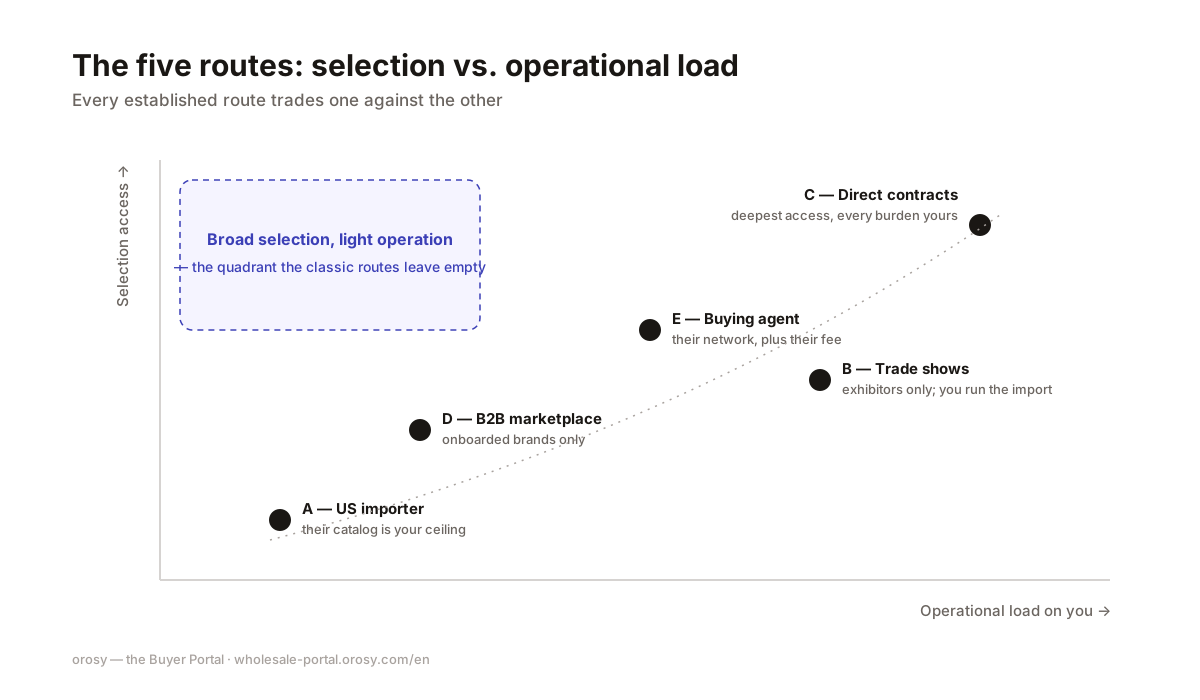
The five routes trade selection against operational load, and the classic routes leave the broad-selection, light-operation quadrant empty.
Selection is decided upstream of you
Look again at Route A, the most common starting point. Your assortment is bounded by the catalog that importer chose to bring in. You are selecting from a selection: they made bets on categories, brands, and price points before you arrived, and you inherit those bets whether or not they match your customers.
That is structural, not a flaw in any particular importer. Every intermediated route adds a curation layer, and each layer narrows the set of products you can see before you make a single buying decision. The marketplace shows you onboarded brands. The agent shows you their network. The importer shows you their warehouse.
How a US retailer places a wholesale order from Japan, step by step
Whichever route you pick, a cross-border wholesale order has the same skeleton. The right-hand column is the orosy version of each step, showing what moves off your desk and what never does.
| Step | What you do | What happens on orosy |
|---|---|---|
| 1. Get verified as a business | Give your company name, business site URL, what you sell, where your business is, and where you want deliveries | Registration and use cost nothing, and no card is needed to join; a card is needed before you place a real order. Most accounts are approved within about 10 minutes if the registered email matches the business site domain or appears on the site; otherwise a person reviews it and you normally hear back within 12 hours |
| 2. Try before approval | Test the flow without committing | Test mode lets you search, build a cart, and place a test order. No supplier is notified, nothing ships, nothing is charged |
| 3. Build the assortment | Choose products across several suppliers | One catalog and one cart. orosy carries the negotiation and account opening with each supplier |
| 4. Clear the minimums | Meet each supplier's order unit and any minimum order amount | Shown per product and per delivery group before you commit |
| 5. Set the destination | Enter the delivery country and address | The cart shows a reference figure for international shipping before you order |
| 6. Pay | Pay for the order | Credit card only. You are charged when stock is confirmed, and items that turn out to be unavailable are not charged |
| 7. Ship | Move the goods to your country | orosy arranges the international shipping to your country |
| 8. Clear customs | File the entry and pay duty and tax at import | This stays with you, on every route |
Three notes on the steps that surprise first-time buyers.
The business check is the gate, not the card. Real prices open after a platform confirms you are a business; on orosy that check uses your business site URL.
Delivery goes to your own business location. Your store, warehouse, or office is the destination; orosy does not ship to your end customers.
The same catalog is reachable by code. An AI client that can set an API key in a request header can search, build a cart, and order through the API, presenting a total for a person to confirm.
Before you order, the cart shows a reference figure for international shipping, for your information only. The actual shipping cost is calculated later and billed to you, and it can differ from that figure.
Do you pay tariffs when you order from Japan?
Yes. Duties and taxes owed at import into the US are real on every route, and they are the importer's responsibility. What differs is whether you see the line item or whether it is buried in a domestic price.
Under the 2025 US–Japan framework agreement, most Japanese consumer goods are tariffed at roughly 15%, and the structure matters more than the headline. The 15% is inclusive of the pre-existing most-favored-nation rate rather than stacked on top of it: many categories were aligned to that level, and goods already above it keep their existing rate. The exact figure comes back to the product's HTS classification, so it varies by category rather than applying as one flat number. (Congressional Research Service, White House Federal Register notice)
Two facts make planning easier. Duties on most consumer goods are ad valorem, a percentage of value, so the rate does not change whether you import $1,000 or $100,000 of goods (a few categories carry per-unit or compound rates instead; check the HTS line). And the duty exists on every route: buy from a domestic importer and someone already paid it, with the cost inside your price.
| Route | Who files the customs entry | How the duty reaches you |
|---|---|---|
| A. US importer / distributor | The importer | Already inside the domestic wholesale price |
| B. Trade show direct | You | Billed to you at import |
| C. Direct manufacturer / wholesaler | You | Billed to you at import |
| D. B2B marketplace | Depends on whether stock is in-region or sent from Japan | Inside the price for in-region stock; billed to you for direct shipments |
| E. Buying agent / trading company | Often the agent, on your instruction | Passed through to you, usually with a service fee |
When you price a first order, build the whole stack rather than wholesale prices alone: our walkthrough of importing Japanese products: customs, duties, and logistics covers the mechanics, and the landed-cost model for Japanese products turns it into a number you can set next to a shelf price.
orosy — the Buyer Portal
orosy is built for the trade-off this guide describes: a buyer should not have to choose between broad selection and a manageable operation. The name comes from the Japanese word orosu (卸す), "to wholesale." The catalog is not bounded by what one importer chose to stock. For shipping to the US it is stationery, over 50,000 products (measured 2026-10-19), drawn from the 5,000+ brands and suppliers on its Japanese marketplace that are joining it over time. orosy handles the negotiating and opens the account with each supplier, so products from different suppliers go into one cart and settle on one invoice.
orosy arranges the international shipping to your country. You do not need a forwarder or a receiving point in Japan. Before you order, the cart shows a reference figure for international shipping, for your information only. The actual shipping cost is calculated later and billed to you, and it can differ from that figure. Customs clearance in your country, import duties, and taxes at import are your responsibility. They are not part of the cost billed by orosy. Delivery to a receiving point inside Japan also remains available.
If you run a Shopify store, there is a fourth way in that skips the setup. The orosy Wholesale app is free to install and puts the search, the cart and the ordering inside the Shopify admin, with no API key to issue. Picked products become Shopify products with your markup on each variant, and received stock goes into Shopify inventory from the order page. The wholesale rules do not change: order units and delivery-group minimums are still checked in the cart, business verification still comes before the first order, and ordered stock is billed by orosy. We walk through it in sourcing Japanese wholesale inside the Shopify admin.
FAQ
How can I order products from Japan to the USA as a business?
Open an account with a supplier, importer, or B2B platform that sells at wholesale, get verified as a business, build an order that clears each supplier's minimum, pay, and arrange the international leg. On orosy: register with your company name, business site URL, what you sell and your two countries — where the business is and where deliveries go — search, build a cart, and place a test order while your account is reviewed, build one cart across several suppliers, and pay by credit card when stock is confirmed. orosy arranges the international shipping to your country. Customs clearance in your country, import duties, and taxes at import are your responsibility.
Do I have to pay tariffs if I order from Japan?
Yes. Goods entering the US are dutiable, and the rate follows the product's HTS classification rather than the size of your order. Under the 2025 US–Japan framework, most Japanese consumer goods land at roughly 15%, inclusive of (not added to) the pre-existing most-favored-nation rate. Between routes, what changes is visibility rather than existence: buy from a US importer and the duty already sits inside the price you pay; buy direct from Japan and you pay it yourself at import.
Where can I buy wholesale Japanese products?
Five routes are in real use: US-based importers and distributors of Japanese goods, Japanese trade shows such as the Tokyo International Gift Show, direct accounts with Japanese makers and wholesalers, B2B marketplaces that carry a Japanese section, and buying agents or trading companies. Online it narrows to three shapes: a distributor's own catalog, a general B2B marketplace, or a platform built around Japanese supply. The route decides how wide your selection is and how much cross-border work lands on your desk.
How do I buy wholesale directly from a Japanese manufacturer?
Identify the maker, approach them with a business introduction and a clear description of your sales channel, agree terms under Japanese business practice, and meet the minimum order quantity they set for the domestic market. You then act as the importer of record: export documents, freight, customs clearance, and duties are yours. It gives the deepest access and the best unit economics, but it is the slowest route to a first test order, so most buyers start elsewhere and go direct later on the lines that sell.
Has Japan suspended shipping to the USA?
Carriers and postal operators change their rules, service levels, and accepted items from time to time, so any status printed in an article ages quickly. Check the current terms of whichever service you book yourself. The more useful question is who carries that work: orosy arranges the international shipping to your country. You do not need a forwarder or a receiving point in Japan. Delivery to a receiving point inside Japan also remains available.
How does orosy differ from a US importer?
A US importer's catalog is fixed by what they chose to import, so your assortment is bounded upstream of you, and duty and freight already sit inside the domestic price. orosy puts many Japanese suppliers behind one catalog, and what you can order depends on where the goods are going. For shipping to the US it is stationery, over 50,000 products (measured 2026-10-19). If you take delivery at a receiving point inside Japan instead, the catalog is larger, about 200,000 products. Separately, the 5,000+ brands and suppliers on its Japanese marketplace are joining this catalog over time. orosy handles the negotiating and opens the account with each supplier, and arranges the international shipping to your country. Before you order, the cart shows a reference figure for international shipping, for your information only. The actual shipping cost is calculated later and billed to you, and it can differ from that figure. Customs clearance in your country, import duties, and taxes at import are your responsibility. They are not part of the cost billed by orosy.
Sources
- Teikoku Databank — 2025 survey on the average age of Japanese company presidents: https://www.tdb.co.jp/report/economic/20260216-presidentage2025/
- Tokyo International Gift Show — official site: https://www.giftshow.co.jp/english/tigs/
- Faire — Japanese products discovery: https://www.faire.com/discover/japanese-products
- Faire — international selling requirements: https://www.faire.com/support/articles/4407511671579
- Faire — costs and account requirements: https://www.faire.com/support/articles/360040446591
- Gifts & Decorative Accessories — a retailer's perspective on Faire: https://www.giftsanddec.com/blog/savvy-store-solutions/how-fair-is-faire-really-a-retailer-gives-her-perspective-carol-schroeder/
- SUPER DELIVERY (Japanese wholesale marketplace for overseas buyers): https://www.superdelivery.com/en/
- US Tariffs and the 2025 US–Japan Framework Agreement, Congressional Research Service: https://www.congress.gov/crs-product/IN12608
- Implementing Certain Tariff-Related Elements of the United States–Japan Agreement, Federal Register: https://www.federalregister.gov/documents/2025/09/16/2025-17908/implementing-certain-tariff-related-elements-of-the-united-states-japan-agreement