Quick answer: The Tokyo International Gift Show is Japan's largest gift and lifestyle trade fair, held twice a year at Tokyo Big Sight with roughly 3,000 exhibitors. It is a trade-only event, so you register in advance and attend as a business buyer — the general public can't enter. For a US buyer, the value isn't closing orders on the floor; it's seeing product in person and meeting makers face to face. The harder, more important work happens after the show: opening accounts, confirming each supplier can actually export to you, arranging samples, and taking on customs and freight yourself. This guide walks through planning the trip, working the floor, the etiquette of Japanese business meetings, and how to set up the follow-up so the trip pays off.
Key takeaways
- The Tokyo International Gift Show (TIGS) runs twice a year at Tokyo Big Sight with roughly 3,000 exhibitors — it is a trade-only event you must register for in advance.
- The show is too large to walk without a plan: build a target list of exhibitors before you fly, and book appointments where you can.
- Deals rarely close on the floor. A face-to-face meeting opens a relationship; the account, samples, and terms get settled afterward.
- The post-show work is the real job — opening accounts, confirming a supplier can export, arranging samples, and handling customs and freight yourself.
- If you can't make the trip, or want to test demand before committing to one, sourcing Japanese product without flying to Tokyo is also a route.
Why a US buyer would go to Tokyo at all
If you've tried sourcing Japanese product from the US, you already know the supply side is fragmented. Thousands of small and mid-size makers and wholesalers have built their products for the domestic market and sold through long-standing domestic relationships — so much of what Japan makes was never set up to be found from overseas. A trade show solves part of that problem in one move: it puts a few thousand of those suppliers in one building, with product you can touch and people you can talk to.
The Tokyo International Gift Show (TIGS) is the largest of these events. For a buyer building a differentiated, hard-to-copy assortment, walking the show is one of the few ways to meet makers directly and see categories you'd never surface through a US importer's catalog. That access is the upside. The trade-off — which this guide is honest about throughout — is that going direct means you carry the export, language, and logistics work yourself once the handshake is over.
This is a business trip, not a sightseeing one. Plan it like a buying calendar, not a vacation.
What TIGS is: dates, scale, and venue
TIGS runs twice a year at Tokyo Big Sight (the Tokyo International Exhibition Center) in Ariake, Koto-ku, Tokyo. It is organized by Business Guide-Sha, Inc.
For 2026, the two editions are:
- 101st edition — Spring 2026: February 4–6, 2026 (Tokyo Gift Show — official news release, JETRO J-messe)
- 102nd edition — Autumn 2026: September 2–4, 2026, open 10am–6pm on Sep 2–3 and 10am–5pm on Sep 4 (Tokyo Gift Show — outline)
The show fills roughly 100,000 m² and brings together about 3,000 exhibitors (including concurrent shows) across categories like home décor, tableware, stationery, fashion accessories, toys, cosmetics, interior goods, and food gifts. Several concurrent exhibitions run under the same roof and the same badge — for the spring 2026 edition these were LIFE×DESIGN, LIVING & DESIGN, and a gourmet food section. (Tokyo Gift Show — outline)
Two things to internalize from those numbers. First, the scale: 3,000 exhibitors across 100,000 square meters is more than you can walk thoroughly in three days, let alone one. Second, the cadence: because the show happens on a fixed twice-a-year calendar, it sets the timing of this sourcing route. You build the trip around the show dates, not the other way round.
Before you fly: registration, targets, and appointments
The single biggest determinant of whether the trip is worth it is the preparation you do before you land. Three pieces matter.
- Register in advance — it's a trade-only event — TIGS is a trade fair for business professionals in the distribution industry. The general public and students are not admitted, and children under 12 and pets aren't allowed in. You register online ahead of time; you don't need a pre-issued invitation to do so — professionals can register directly through the official page. A single badge is valid for all three days, so you don't re-register each morning. Note that the organizer provides visa support for exhibitors but not for visitors, so handle your own travel documentation. (Tokyo Gift Show — FAQ)
- Build a target exhibitor list — Don't plan to "walk the whole show." Use the official exhibitor directory — searchable in English — to build a shortlist before you go. Filter by the categories you actually buy, flag the booths you must see, and group them by hall so your route is efficient. A focused list of 30–50 priority exhibitors will serve you far better than wandering 3,000 booths and running out of time and energy on day one.
- Book appointments where you can — For your highest-priority makers, try to set a meeting time in advance rather than hoping to catch them at the booth. Popular exhibitors get crowded, and a scheduled slot means you actually get the maker's attention instead of a brochure handed to you between conversations. Even a loose "we'll come by Tuesday morning" email, sent ahead, raises your odds of a real conversation.
A practical add-on: prepare your own materials before you go. Bring business cards (ideally with a Japanese side if you can arrange it), a one-page description of your stores or distribution and the categories you buy, and a clear sense of the order sizes and terms you can realistically commit to. Suppliers will size you up quickly; showing that you understand wholesale makes the conversation move.
On the floor: how to actually work the show
Once you're inside, the goal shifts from coverage to selection. You won't see everything — accept that — so spend your time well.
- Hit your priority booths first — Work your target list before you let yourself browse. Energy and time both run down fast across a hall the size of Big Sight, and the meetings you planned are worth more than the ones you stumble into.
- Look, photograph (when allowed), and take structured notes — Ask before photographing — some makers restrict it — and capture booth name, product, wholesale price, minimum order quantity, lead time, and whether the supplier has any experience exporting. A consistent note format per booth saves you from a blur of half-remembered conversations on the flight home.
- Ask the export question early — For a US buyer this is the question that filters everything: can this supplier actually sell to you and ship abroad? Many excellent makers sell only domestically and have never exported. Knowing that up front tells you whether a booth is a real lead or just inspiration.
- Leave room to discover — After your priorities are covered, give yourself unstructured time to walk adjacent categories. The unplanned find — a maker you'd never have searched for — is often the reason direct sourcing beats a pre-filtered catalog. Just don't let discovery eat the meetings that brought you there.
Meeting etiquette and realistic expectations
Japanese business meetings follow norms that are worth respecting, and a US buyer who walks in expecting a same-day deal will usually be disappointed. None of this is exotic — it's just different from a typical American trade-show interaction.
Business cards matter. The exchange of meishi (business cards) is a small ritual: offer and receive cards with both hands, take a moment to look at the card you're given rather than pocketing it immediately, and treat it with care. It signals that you take the relationship seriously, which is the currency these meetings run on.
Deals don't close on the floor. Expect the booth conversation to be a first step, not a contract. You're establishing that you're a serious buyer, learning the product, and opening a line of communication. Pricing, minimums, samples, and terms typically get settled afterward, over email, once both sides have had time to consider. A maker who doesn't commit on the spot isn't brushing you off — that's the normal pace.
Patience reads as professionalism. Pushing for an immediate yes can work against you. Showing that you understand the longer relationship — and that you'll follow up properly — does more to win an account than pressure ever will.
Set your own expectations accordingly: a good show might end with a stack of cards, a set of photographed products, and a handful of makers who are genuinely interested. That's a successful trip. The orders come later.
After the show is the real job
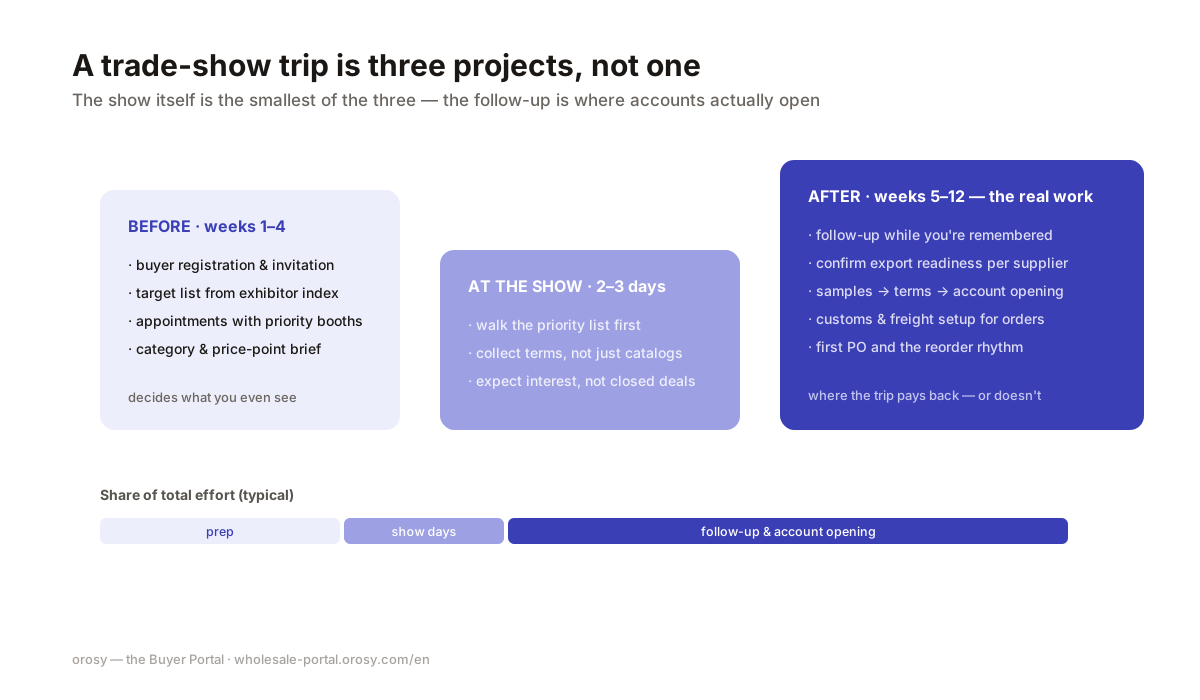
A trade-show trip is three projects, not one — and the follow-up is the biggest.
Here's the part that catches first-time buyers off guard: the trip to Tokyo is the easy half. The handshake at the booth doesn't put product in your warehouse — what follows does, and it's on you.
The post-show work usually breaks down into a few tracks:
- Open accounts. Turn the cards and conversations into actual supplier accounts — the application, documentation, and payment terms each maker requires. This is administrative, and it takes longer across a language gap.
- Confirm each supplier can export. A maker being interested isn't the same as being export-ready. Many sell only into the domestic market and aren't set up to ship abroad, invoice in your currency, or act as exporter. Confirm this early, before you build a plan around a supplier who can't actually ship to you.
- Arrange samples. Get product in hand before you commit to a real order, and budget for the time and cost of shipping samples internationally.
- Take on customs and freight. Going direct makes you the importer of record. You own import duties, international freight, and clearance — and those costs belong in your landed-cost model from day one, because they apply to every Japanese import regardless of route.
This is the honest constraint of the trade-show route, and it's the same constraint we lay out in our complete guide to sourcing Japanese products wholesale: the show gives you the broad, differentiated selection that a US importer's catalog can't, but in exchange you operationalize export, language, and logistics yourself. If you're new to that operational side, our breakdown of importing Japanese products — customs, duties, and logistics walks through what the post-show paperwork and shipping actually involve. Plan for that work before you fly, not after you're home with a stack of business cards and no process to act on them.
If you can't make the trip this year
The show is a strong route, and nothing here argues against going — for the right buyer, walking TIGS is genuinely one of the best ways to build a distinctive Japanese assortment. But it isn't the only route, and the trip isn't always feasible: the calendar is fixed twice a year, travel and time are real costs, and even after a great show you still have to stand up the export operation yourself.
If you can't make a given edition, or you'd rather test demand before committing to the trip, you can source Japanese product without flying to Tokyo. orosy ("orosy — the Buyer Portal," from the Japanese orosu / 卸す, "to wholesale") connects US buyers to a wide breadth of Japanese supply — 5,000+ Japanese brands and suppliers, about 200,000 products, and 20,000+ buyers on the marketplace, founded in 2018. Rather than opening an account with each exhibitor you liked and then arranging the shipment yourself, you buy from suppliers orosy has already contracted, a multi-supplier order arrives as one cart and one invoice, and orosy arranges the international shipping to your country. You do not need a forwarder or a receiving point in Japan.
The post-show arithmetic still belongs to you. Before you order, the cart shows a reference figure for international shipping, for your information only. The actual shipping cost is calculated later and billed to you, and it can differ from that figure. Customs clearance in your country, import duties, and taxes at import are your responsibility. They are not part of the cost billed by orosy. It's a way to reach across Japan's shelf between shows, with the freight leg estimated up front instead of negotiated.
FAQ
When and where is the Tokyo International Gift Show held in 2026?
TIGS runs twice a year at Tokyo Big Sight in Ariake, Koto-ku, Tokyo. The 101st edition (Spring 2026) was held February 4–6, 2026, and the 102nd edition (Autumn 2026) is scheduled for September 2–4, 2026, with hours of 10am–6pm on the first two days and 10am–5pm on the final day.
Can anyone attend the Tokyo International Gift Show, or is it trade-only?
It is a trade-only event for business professionals in the distribution industry. The general public and students are not admitted, and children under 12 and pets aren't allowed in. You register in advance online — you don't need a pre-issued invitation to register — and a single badge is valid for all three days.
How big is the show, and can I see all of it in one day?
No. TIGS spans roughly 100,000 m² with about 3,000 exhibitors across many categories. It's too large to walk thoroughly even in three days, which is why building a target exhibitor list before you go — and booking appointments with priority makers — matters more than trying to cover the whole floor.
Will I be able to place orders on the show floor?
Usually not. A booth meeting is the start of a relationship, not a closed deal. You exchange business cards, see product, and open a line of communication; accounts, samples, pricing, and terms typically get settled afterward over email. Plan for the post-show follow-up — opening accounts, confirming each supplier can export, arranging samples, and handling customs and freight — to be the real work of sourcing this way.
Sources
- Tokyo International Gift Show — outline (102nd Autumn 2026 dates, venue, hours, exhibitors): https://www.giftshow.co.jp/english/tigs/outline.htm
- Tokyo International Gift Show — FAQ (trade-only admission, registration, badge, visa note): https://www.giftshow.co.jp/english/tigs/faq.htm
- Tokyo International Gift Show — 101st (Spring 2026) news release: https://www.giftshow.co.jp/english/tigs/pdf/101tigs_newsrelease.pdf
- The 101st Tokyo International Gift Show Spring 2026, JETRO J-messe trade fair database: https://www.jetro.go.jp/en/database/j-messe/tradefair/detail/157953