Quick answer: The number you need is not the tariff rate, it is the landed cost: product plus duty plus freight plus clearance, per unit, on your shelf. Building it takes four inputs. The tariff structure under the 2025 US–Japan framework aligns most covered consumer goods to roughly 15%, inclusive of the existing MFN rate rather than stacked on it. Your specific rate comes from your HTS classification, which is public and searchable. Clearance makes you the importer of record and usually means engaging a licensed customs broker. Freight is chosen by volume, from parcel through palletized ocean to a full container. This guide walks each input and then carries one order through the arithmetic to a landed figure.
Key takeaways
- The 2025 US–Japan tariff is inclusive, not additive. Covered goods are aligned to a 15% level rather than having 15% added to the duty you already paid, and this is where buyers most often misjudge their costs.
- Because it is inclusive, a category that previously entered at 0% now carries duty, while a category whose existing rate was already above 15% keeps that higher rate unchanged.
- Your actual rate comes from your product's HTS classification, which you can look up yourself at hts.usitc.gov before anyone gives you a figure.
- US duties here are ad valorem, so the percentage is identical on a $1,000 order and a $100,000 one. Volume improves your freight per unit, not your duty rate.
- Every route carries duty, clearance, and freight. What differs between routes is who does the work and whether the cost is itemized or folded into a price you cannot see through.
Duties are a structure, not a wild card
If you are weighing whether to bring Japanese product into your assortment, the word "tariffs" probably triggers a small alarm. The 2025 headlines were loud, the numbers moved, and it is easy to assume importing from Japan has become a guessing game.
It has not. Duties on Japanese consumer goods follow a defined structure: a rate set by your product's classification, applied as a percentage of value, under a framework that is published and public. Once the four moving parts are clear, importing stops being a fear and becomes a line in a model you control.
This is a buyer's reference, not legal or customs advice. Rates and rules shift, and for your specific products you should consult a licensed customs broker.
1. How the tariff is built
In 2025 the US and Japan reached a framework trade and investment agreement, and Executive Order 14345, signed September 4, 2025, implemented its tariff elements. The headline everyone remembers is "15%." That is roughly right for many consumer goods, but how it is constructed matters more than the figure. (Congressional Research Service, The White House)
The 15% is inclusive, not additive. The framework aligns covered Japanese goods to a 15% level. It does not bolt 15% on top of the duty you were already paying. The order's language is precise: where a product's existing Column 1 (MFN) rate is below 15%, the sum of that MFN rate and the additional rate "shall be 15 percent." Where the MFN rate already sits at or above 15%, the additional rate "shall be zero," and the existing higher rate simply stays.
| Product's existing MFN rate | Effective rate after the agreement | What it means for you |
|---|---|---|
| 0% (no duty before) | Raised to 15% | Categories that used to enter free now carry a duty — the biggest cost change to plan for |
| Above 0% but under 15% | Aligned up to 15% | The gap to 15% is added; it is not a separate stacked tariff |
| Already 15% or higher | Stays at the existing rate | No additional duty; the pre-existing higher rate remains in force |
So "everything is 15%" is a useful first approximation and not literally true. The honest summary: most covered Japanese consumer goods sit around 15% on an MFN-inclusive basis, the exact figure varies by category, and a few sit higher.
Watch out: The 2025–2026 US trade landscape is set largely by executive action and remains subject to change, including ongoing litigation. Treat any specific rate here as a starting point to verify rather than a fixed figure. Your customs broker and the live HTS schedule are the authorities for your shipment on the day it enters.
One more property worth internalizing: these duties are ad valorem, assessed as a percentage of value. The rate on a $1,000 order equals the rate on a $100,000 order. Importing a full container improves your freight per unit and your supplier pricing; it does not earn a lower duty rate.
2. Finding your own rate
Every figure above hangs on your product's HTS classification. The Harmonized Tariff Schedule of the United States assigns a 10-digit code to every importable good, and that code determines the duty rate, any special provisions, and the paperwork. Two products that look alike to a buyer can sit in different headings at different rates, which is exactly why "roughly 15%" has to become a real number before you commit.
- Describe the product precisely — Material, function, and form all matter. "A ceramic mug" is not enough: porcelain and non-porcelain stoneware sit in different headings within Chapter 69, at materially different rates.
- Search hts.usitc.gov — Start with a plain-English term, then narrow to heading and subheading. Read the Column 1 "General" rate. That is your MFN starting point, before the framework logic applies.
- Apply the inclusive logic — Under 15% aligns up to 15%. At or above 15% stays put. That gives you a working effective rate for a Japan-origin good.
- Have a broker confirm it — Classification is a legal determination with real consequences for getting it wrong. Some goods carry specific or compound duties (a per-unit charge plus a percentage) that do not map cleanly onto the 15% rule at all.
Three category examples show how much this matters. Toys (heading 9503) historically entered at 0% MFN, so a formerly duty-free category is pulled up toward 15%. Non-porcelain ceramic tableware (6912) carried a mid-single-digit to low-double-digit rate and aligns up to 15%. Porcelain tableware (6911) has historically carried a much higher rate, and because that rate already exceeds 15%, it stays high. (Congressional Research Service)
3. What clearance actually involves
You become the importer of record. That is the entity legally responsible for goods being correctly declared, valued, and classified, and for duties and fees being paid. Contract a Japanese supplier directly and bring product in under your own name, and that entity is you. The responsibility is real and non-transferable except to a party that explicitly takes it on.
Entry requires documentation. A standard import entry typically involves a commercial invoice stating what the goods are and what they cost, a packing list, a bill of lading or air waybill, and the entry filing itself with US Customs and Border Protection. Accuracy keeps a shipment moving; errors are what get it held.
A broker is standard infrastructure. A licensed customs broker files entries on your behalf, advises on classification and valuation, and interfaces with CBP. For anyone importing regularly this is less a luxury than a utility. It is also where first-time importers most underestimate the load: clearance is not a form but an ongoing documentation discipline.
Note: Commercial importing and the small-parcel "de minimis" world are different games. The US ended the $800 de minimis exemption for most shipments in 2025, which mainly affected direct-to-consumer parcels. Commercial wholesale lots typically exceed those thresholds and have always cleared as formal entries with duty owed, so for a B2B buyer this change is largely a non-event. (CBP, CRS R48380)
4. Choosing a freight lane
Freight is the other cost that never disappears, and the right mode depends almost entirely on volume. Pricing moves with route, season, and carrier, so the comparison below is about fit rather than figures.
| Mode | When it fits | Transit profile | Trade-off |
|---|---|---|---|
| Small parcel / express air | Samples, first test orders, very low volume | Quick transit | High cost per unit; does not scale to replenishment |
| LCL (palletized ocean, less than container) | Mid-volume orders that do not fill a container | Slower ocean transit | Shared container; you pay for the space used, plus consolidation handling |
| FCL (full container, ocean) | High, regular volume | Slower ocean transit | Strong unit economics; you commit to filling or paying for the container |
Most growing buyers walk this curve: testing on air, replenishing by LCL, moving to FCL once a SKU proves out. Freight mode changes your lead time and your working capital, not only your unit cost, which is why it belongs inside the model rather than bolted on after you have chosen a supplier.
5. Assembling the model
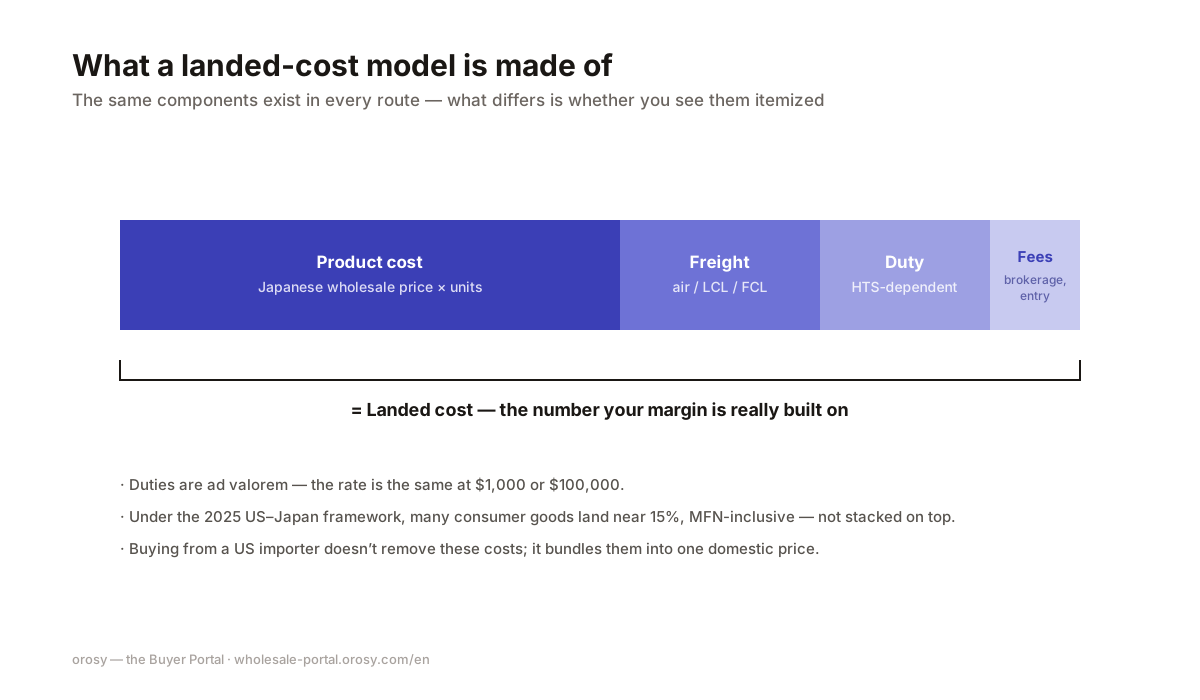
Landed cost = product + freight + duty + fees. The components exist in every route; what differs is whether you see them itemized.
Landed cost is the all-in cost to get one unit onto your shelf ready to sell. It is the only number that compares sourcing routes honestly, because a low product price means little if duty and freight quietly erase the margin.
| Component | What it is | Notes |
|---|---|---|
| Product (ex-works) cost | The unit price from the supplier | The base everything else stacks onto |
| Import duty | Tariff on the goods' value | Apply the inclusive rate for your HTS code — Sections 1 and 2 |
| International freight | Moving goods Japan to US | Mode-dependent; allocate per unit |
| Brokerage & clearance fees | Broker service and entry filing | Recurring per shipment |
| Other entry fees | Government processing and handling charges | Confirm current applicable fees with your broker |
| Domestic handling & last mile | Warehousing and inland freight to you | Routinely forgotten; varies by destination |
6. One order, carried through
Structure is easier to trust once you have watched it produce a number. The figures below are round and illustrative, chosen to show how the components interact rather than to describe any real shipment.
Start with a $5,000 ex-works order of a Japanese consumer good whose classification aligns to 15%, moving by palletized ocean freight.
- Product: $5,000
- Duty at 15% of value: $750
- Ocean freight and consolidation, allocated to this order: $400
- Brokerage, entry filing, and handling: $250
- Landed: $6,400, or 128% of the ex-works price.
That ratio is the number to carry in your head. A supplier's price is roughly four-fifths of what the goods will actually cost you, and a "cheap" direct price that beats a domestic importer by 15% has not beaten it at all.
Now change one variable at a time, because that is where the decisions live.
Change the freight lane. Move the same order by express air rather than ocean and the freight line rises sharply while every other line holds. Air buys weeks of lead time at a price per unit; on a first test order that can be worth paying, and on replenishment it rarely is. The duty does not move, because duty follows value and not weight.
Change the category to one that used to be duty-free. Run the same $5,000 through a formerly 0% category such as toys. Before the framework the duty line was zero and the landed figure was $5,650. Now it carries $750 of duty like everything else. Nothing about the product, the supplier, or the freight changed; a category that used to import free simply stopped being free, and any pricing built on the old assumption is now short by 15% of goods value.
Change the category to one already above 15%. Porcelain tableware under heading 6911 does not land at $6,400, because its pre-existing rate is higher than 15% and stays. The point is not the exact figure, which you look up for your own code. The point is that assuming a flat 15% across an assortment will under-model your porcelain and misprice it, and the error scales with every order.
What does not change with size. Ten times the order gives you $50,000 of product and $7,500 of duty: the same 15%. Your freight per unit improves and your brokerage is spread across more units, so the landed ratio drifts down modestly. Scale earns you freight and supplier economics, never a better duty rate.
The discipline this produces is simple and easy to skip: sum these components for the same basket of goods on each route you are considering, and compare the landed totals rather than the headline prices. A direct-from-Japan price often looks unbeatable until duty, freight, and clearing narrow the gap. A domestic importer's price already contains every one of these lines, which is convenient and means they were decided for you, inside a markup you cannot read.
7. The question underneath all of this
Notice what every section has in common. The duty exists regardless of route. The classification, the entry filing, the freight booking, and the model all have to be done by someone.
So the question that decides your sourcing strategy is not "are there duties." It is who carries this work, and how visible are the costs to me. That is the same trade-off at the heart of choosing a route: take on more of the operation and you reach broader supply; hand more off and the catalog arrives pre-filtered. We compare the routes in our companion guide.
→ How to source Japanese products wholesale in the US
orosy — the Buyer Portal
Everything in this article is work. Someone classifies the goods, files the entry, books the freight, and keeps the model honest. For most buyers, assembling those functions is the real barrier to Japanese supply rather than the duty itself.
The name comes from the Japanese word orosu (卸す), "to wholesale." Founded in 2018, orosy connects US buyers to a wide breadth of Japanese supply, with 5,000+ Japanese brands and suppliers, about 200,000 products, and 20,000+ buyers on the marketplace, rather than being limited to whatever one importer chose to stock. orosy carries the individual negotiations and account opening with each supplier, so the part of this guide about finding and qualifying a Japanese source is already done when you open the catalog. A multi-supplier order is one cart and one invoice, and orosy arranges the international shipping to your country. You do not need a forwarder or a receiving point in Japan.
Be precise about which part of this guide that removes and which part it does not. Before you order, the cart shows a reference figure for international shipping, for your information only. The actual shipping cost is calculated later and billed to you, and it can differ from that figure. Customs clearance in your country, import duties, and taxes at import are your responsibility. They are not part of the cost billed by orosy. Everything above about classification, valuation, and clearance still applies to you as the importer — what changes is that the freight leg arrives as an up-front reference figure (which can change) instead of a forwarder negotiation. Delivery to a receiving point inside Japan also remains available.
FAQ
How much are import duties on products from Japan to the US?
Under the 2025 US–Japan framework, many Japanese consumer goods land at roughly 15%, and that figure is inclusive of the existing most-favored-nation rate rather than stacked on top of it. The exact rate depends on your HTS classification: categories that previously entered at 0% are pulled up toward 15%, while categories whose MFN rate already exceeded 15%, such as porcelain tableware, keep their higher existing rate. Duties are ad valorem, so the percentage holds at any order size. Confirm your rate at hts.usitc.gov and with a licensed customs broker.
How do I find the tariff rate for a specific Japanese product?
Look the product up in the Harmonized Tariff Schedule at hts.usitc.gov. Describe the goods precisely, since material and function both change the heading, then read the Column 1 "General" rate. Apply the framework logic: an MFN rate under 15% aligns up to 15%, and a rate already at or above 15% stays as it is. Because classification is a legal determination, have a broker confirm the code and the actual landed duty for your SKUs.
What does a landed-cost model need to include?
Product cost from the supplier, import duty for your HTS code, international freight allocated per unit, brokerage and entry fees, any other applicable government charges, and domestic handling and last-mile costs. On a worked example of a $5,000 order at a 15% rate, those components take the landed figure to roughly 128% of the ex-works price. Compare landed totals across routes rather than headline product prices, because a domestic importer's price already contains all of the same lines inside a markup you cannot see itemized.
Do larger orders get a lower duty rate?
No. US duties here are ad valorem, so the percentage is identical whether the order is $1,000 or $100,000. What scale improves is everything around the duty: freight per unit falls, per-shipment brokerage spreads across more units, and supplier pricing often improves with volume. Plan volume decisions around those levers rather than expecting the duty rate to move.
Do I need to be the importer of record, and do I need a broker?
If you import under your own company name, you are the importer of record, legally responsible for declaring, classifying, and valuing the goods and paying duties. Most buyers engage a licensed customs broker to file entries, advise on classification, and interface with CBP. Buying from a domestic importer or a sourcing partner that carries the import means that party holds the role instead.
Sources
- US Tariffs and the 2025 US–Japan Framework Agreement, Congressional Research Service: https://www.congress.gov/crs-product/IN12608
- Implementing the United States–Japan Agreement, The White House (Executive Order 14345): https://www.whitehouse.gov/presidential-actions/2025/09/implementing-the-united-states-japan-agreement/
- Harmonized Tariff Schedule of the United States, US International Trade Commission: https://hts.usitc.gov
- E-Commerce and De Minimis, US Customs and Border Protection FAQ: https://www.cbp.gov/trade/basic-import-export/e-commerce/faqs