Quick answer: Ankorstore is one of the strongest wholesale marketplaces in Europe — founded in Paris in 2019, it reached a $2B valuation by 2022 and connects 30,000+ European brands with 300,000+ independent retailers, with net-60 terms and low minimums that retailers love. The catch for this article's reader is simpler than a flaw: Ankorstore is built for European retailers buying European brands. It doesn't operate as a US buying platform, and Japanese supply isn't really on it. If you're a US buyer trying to put Japanese products on your shelf, the honest comparison isn't "Ankorstore or orosy" — it's whether you find and contract Japanese suppliers yourself, or buy from a source that has already done that and arranges the shipping. This guide lays that out neutrally.
Key takeaways
- Ankorstore is genuinely excellent at what it's built for: helping European independent retailers discover European brands, with net-60 terms, low minimums, and a Trustpilot score around 4.3/5 across ~2,965 reviews. This isn't a knock on it.
- It is a European marketplace. Ankorstore's teams sit in France, the UK, Germany, the Netherlands and Sweden, and it sells across roughly 23–25 European markets — it does not operate as a US buying platform.
- Its catalog is European brands. With 30,000+ brands sourced for European independent retail, Japanese supply is effectively absent — not filtered, simply not what the marketplace is for.
- So for a US buyer who wants Japanese products, Ankorstore is a category mismatch on two axes at once: where you are (US, not Europe) and what you want (Japanese supply, not European brands).
- The useful comparison for that buyer isn't Ankorstore vs. orosy — it's sourcing Japanese product direct yourself vs. using a handled model that reaches Japan's breadth for you.
Start here: Ankorstore is very good — at being a European marketplace
If you run an independent shop in France, Germany, or the UK, Ankorstore is probably already on your radar, and for good reason. It rebuilt European wholesale discovery the way Faire did for North America: a clean ordering flow, net-60 payment terms, low minimums (around £100 to try a brand), and free or low-risk returns that let a small retailer test new brands without betting the month's cash on them. (How to sell on Ankorstore, Minderest, Ankorstore — benefits for retailers) Its reputation is solid for a marketplace this size — a Trustpilot score of around 4.3 out of 5 across roughly 2,965 reviews. (Ankorstore metrics summary, ReviewBolt)
So this is not a "Ankorstore is bad" piece. It scaled fast for a reason — to a $2B valuation within two years of launch — by solving a real problem well. (Ankorstore reaches $2B valuation, TechCrunch) The question this guide answers is narrower and more useful if you're a US buyer chasing Japanese product: is Ankorstore even the tool for that job? And the honest answer is that it's a different tool, built for a different buyer and a different supply base.
If you want the full map of how Japanese product reaches the US first, our guide on how to source Japanese products wholesale in the US walks through every route. This piece is specifically about where a European marketplace does — and doesn't — fit that goal.
What Ankorstore gets right
Give it full credit, because these strengths are real and they're why it works for its actual audience.
What European retailers like
- Net-60 terms: receive product and pay up to 60 days later, while brands are paid on delivery — a real cash-flow advantage for a small shop.
- Low risk to try a brand: small minimums (around £100) and low-risk returns let a retailer test new brands without overcommitting.
- Genuine discovery: 30,000+ vetted brands in a modern, browsable flow built specifically for independent retail.
- Solid reputation at scale: a ~4.3/5 Trustpilot score across ~2,965 reviews is a healthy score for a marketplace its size.
Honest caveats (from reviews, not us)
- Fulfillment and support gripes appear in reviews — late or partial deliveries and slow customer service among them. Normal for a high-volume marketplace, but worth knowing.
- Fee structure has shifted over time. Ankorstore has used a retailer-side commission (reported around 20% on a first order from a brand, ~10% on reorders) alongside subscription tiers; verify current terms before you model margin.
The reviews are mixed the way any marketplace at this scale is — strong core experience, with fulfillment and support complaints in the tail. (Ankorstore reviews, Trustpilot) None of that is the point here. The point is upstream of any of it: who Ankorstore is built to serve.
The two mismatches for a US buyer sourcing Japan
For the buyer this blog is written for — a US (or otherwise overseas) business that wants Japanese product — Ankorstore misses on two axes at once. Neither is a defect; both are just what the marketplace is and isn't.
1. Geography: it's a European buying platform. Ankorstore's teams sit in France, the UK, Germany, the Netherlands, and Sweden, and it sells across roughly 23–25 European markets. It is built around European independent retailers and the logistics that serve them. There's no US buying operation to plug into — the whole machine is pointed at intra-European trade. (Ankorstore company profile, via TechCrunch, Wholesale platform comparison, Rural Handmade)
2. Supply: the catalog is European brands. Ankorstore's 30,000+ brands are sourced to stock European boutiques — homeware, grocery, beauty, kids, fashion, jewelry from European makers. Japanese supply isn't filtered out by some rule; it simply isn't what the marketplace assembles. A stray Japan-themed listing may surface, but Japan's actual supply base — the makers and wholesalers who sell into the domestic Japanese market — is not who Ankorstore onboards. (Ankorstore brand catalog)
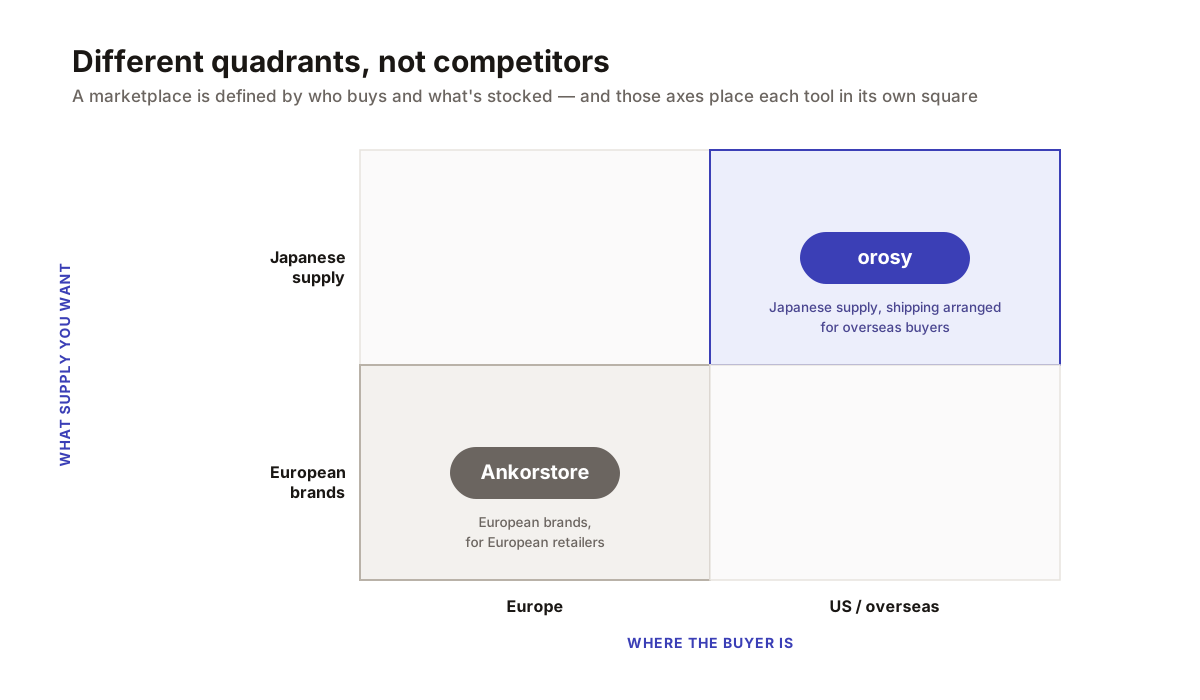
Ankorstore and a Japan-sourcing model don't compete — they sit in different quadrants. The axes that define one exclude the other.
Put the two together and the conclusion isn't "Ankorstore loses to orosy." It's that they don't occupy the same square at all. Ankorstore is the right tool when the buyer is European and the supply is European. The moment either axis flips — a US buyer, or Japanese supply — you're outside what it was built to do.
What this means for you as a US buyer
If your goal is Japanese product on a US shelf, comparing marketplaces by region misses the real decision. Your actual options are two:
Source direct from Japan yourself. Reach Japanese makers and wholesalers, qualify them, negotiate, and run the export, customs, and freight on your own. This gives you the widest possible selection — Japan's full supply base — but it asks you to operate the entire import stack, usually across a language barrier and per-supplier terms. We break down what that takes in how to vet Japanese suppliers and importing Japanese products: customs, duties, and logistics.
Use a handled sourcing model. Reach a broad swath of Japanese supply without holding a relationship with every maker, and with the shipping arranged for you. You trade a little of the do-it-all control for not having to assemble importers and forwarders yourself.
That's the comparison that actually maps to your situation — and neither side of it is a European marketplace.
Ankorstore vs. sourcing direct vs. a handled model: an honest comparison
To make the mismatch concrete, here's how the three stack up for a US buyer who wants Japanese product specifically.
| Ankorstore | Source direct from Japan | Handled sourcing model | |
|---|---|---|---|
| Who it's built for | European independent retailers | Any buyer with in-house import capacity | Overseas buyers who want Japanese supply without running imports |
| Supply base | 30,000+ European brands; Japanese supply effectively absent | Potentially Japan's full supply base — if you can reach and qualify it | A broad breadth of Japanese supply, with shipping arranged |
| Serves US buyers? | No — European markets only | Yes — you are the importer of record | Yes — built for overseas buyers |
| Operational load on you | Low (within Europe) | Highest — language, MOQs, export docs, customs, freight | Lower — one account, with shipping arranged for you |
| Shipping, duties & clearance | Intra-European; not a Japan→US route | Entirely yours as importer of record | orosy arranges shipping, a reference shipping figure is shown before you order and the actual cost is billed to you; duties and clearance stay yours |
| Best fit | A European shop buying European brands | High-volume US buyers with import staff and time | US buyers who want Japan's breadth with the shipping arranged |
The pattern is the one that shows up across Japanese sourcing: the easiest route to operate hands you a curated regional roster, and the route with the widest Japanese selection asks you to run the whole import operation. A handled model exists to break that trade-off — which is the lane orosy sits in, below.
When Ankorstore is the right call (and we mean it)
It would be dishonest to imply Ankorstore is the wrong choice — for the right buyer it's an excellent one. Reach for Ankorstore when:
- You're a European retailer. If your shop is in the EU or UK, Ankorstore's net-60 terms, low minimums, and brand discovery are hard to beat for stocking European product.
- You want European brands. If your assortment is built on European makers, that's exactly the catalog Ankorstore curates.
- Cash-flow timing matters. Net-60 is a concrete, real benefit, and not every route offers it.
Reach for direct sourcing or a handled model instead when your buyer base is in the US, or when the product you want is Japanese — because that's outside what a European marketplace is built to deliver.
Where orosy fits
orosy is built for the buyer this article is written for: the US (or overseas) business that wants Japanese product, without contracting Japanese suppliers one by one or arranging the freight itself.
The name comes from the Japanese word orosu (卸す), "to wholesale." Rather than a regional brand roster, orosy draws on a Japanese marketplace with 5,000+ brands and suppliers and 20,000+ buyers, with the company founded in 2018 and now an equity-method affiliate of giftee Inc. (Tokyo Stock Exchange Prime: 4449). What you can order depends on where the goods are going: the catalog available for shipping to the US is stationery, over 50,000 products (measured 2026-10-23), while the catalog for delivery inside Japan is larger, about 200,000 products. You pick what fits your shelf, orosy carries the negotiations and account opening with each supplier, and orosy arranges the international shipping to your country. You do not need a forwarder or a receiving point in Japan.
Before you order, the cart shows a reference figure for international shipping, for your information only. The actual shipping cost is calculated later and billed to you, and it can differ from that figure. Customs clearance in your country, import duties, and taxes at import are your responsibility. They are not part of the cost billed by orosy. Neither figure is buried in a markup, so your landed-cost model stays yours to build. This isn't a claim that orosy is a cheaper Ankorstore — they serve different buyers and different supply entirely. It's that if your job is "Japanese product, on a US shelf," orosy is built for that job and a European marketplace isn't.
FAQ
Is Ankorstore available in the United States?
Ankorstore operates as a European marketplace. Its teams are based in France, the UK, Germany, the Netherlands, and Sweden, and it sells across roughly 23–25 European markets. It is not built as a US buying platform, so a US retailer can't use it the way a European shop does.
Can I source Japanese products on Ankorstore?
Not in any meaningful way. Ankorstore's 30,000+ brands are sourced for European independent retail — homeware, grocery, beauty, kids, fashion, jewelry from European makers. Japanese supply isn't filtered out by a rule; it simply isn't what the marketplace assembles. For Japanese product you'd source direct from Japan or use a handled model.
Is Ankorstore a good wholesale marketplace?
Yes — for its intended audience. It offers net-60 terms, low minimums, broad European brand discovery, and holds a Trustpilot score around 4.3/5 across roughly 2,965 reviews. The limitation for this article's reader is fit, not quality: it's built for European retailers buying European brands.
Ankorstore vs. sourcing direct from Japan — which should a US buyer choose?
For a US buyer wanting Japanese product, Ankorstore isn't really in the running — it's a European platform with a European catalog. The real choice is sourcing direct from Japan (widest selection, but you run language, MOQs, a relationship per maker, and the freight yourself) versus a handled model (broad Japanese access through one account, with the shipping arranged and a reference shipping figure shown before you order (for your information only); import duties and clearance stay yours in both).
How is orosy different from Ankorstore?
They serve different buyers and supply. Ankorstore connects European retailers to European brands. orosy connects overseas (initially US) buyers to Japanese supply from 5,000+ brands and suppliers, carries the negotiation and account opening with each supplier, and arranges the international shipping. What you can order depends on where the goods are going: the catalog available for shipping to the US is stationery, over 50,000 products (measured 2026-10-23), while the catalog for delivery inside Japan is larger, about 200,000 products. Before you order, the cart shows a reference figure for international shipping, for your information only. The actual shipping cost is calculated later and billed to you, and it can differ from that figure. Customs clearance, import duties, and taxes at import are yours, and are not part of what orosy bills. It's a different job, not a cheaper version of the same one.
Sources
- Ankorstore reaches $2B valuation two years after launch (founding, geography), TechCrunch: https://techcrunch.com/2022/01/09/ankorstore-reaches-2-billion-valuation-two-years-after-launching-its-wholesale-marketplace/
- How to sell on Ankorstore (commission, net-60, minimums), Minderest: https://www.minderest.com/blog/sell-on-ankorstore-marketplace
- Ankorstore — how independent retailers benefit (terms, returns): https://blog.ankorstore.com/ankorstore-benefits-retailers/
- Wholesale platform comparison: Faire vs Ankorstore vs others (European focus), Rural Handmade: https://ruralhandmade.com/blog/comparative-analysis-for-wholesale-platforms-faire-vs
- Ankorstore metrics summary (Trustpilot ~4.3/5, ~2,965 reviews; traffic), ReviewBolt: https://reviewbolt.com/r/ankorstore.com
- Ankorstore brand catalog (European brand base): https://www.ankorstore.com/