Quick answer: For a multi-store retailer, a Japanese section is an assortment play — a differentiated, hard-to-copy line that gives your stores a reason to look unlike the competition, which is exactly what lifts same-store sales over a uniform national assortment. The hard part isn't the product; it's executing it across many stores consistently and replenishing at chain scale. The move is to source the section through one buying relationship — one account, one PO logic, consistent supply to every store — pilot it in a cluster before rolling out chain-wide, price it on a real landed-cost model that includes duties and clearance, and let a single source carry the breadth and arrange the shipping. This playbook walks through it.
Key takeaways
- A Japanese section is an assortment differentiator most chains don't carry — so it sets your shelf apart instead of duplicating the lines every competitor already stocks.
- Differentiated, localized assortment isn't soft positioning; it moves the number. Chains that localize a meaningful share of their range see materially higher same-store sales than uniform-national formats.
- The chain-specific challenge isn't finding product — it's rolling it out consistently across many stores and replenishing it at scale, ideally through one buying relationship rather than per-store improvisation.
- Pilot in a store cluster before you go chain-wide. A new section proven in 10 stores de-risks the rollout to 100.
- Don't build an import desk to do it. One account that carries the breadth and arranges the shipping lets you add the section without contracting Japanese suppliers one by one.
The situation: your stores compete on assortment, and yours looks like everyone's
If you run a chain, you know the squeeze: the lines on your shelves are the lines on your competitors' shelves, so the fight collapses to price and convenience. The way out that retailers keep rediscovering is assortment differentiation — carrying things the chain across town can't.
The data backs the instinct. Industry research finds that retail chains localizing a meaningful share of their range — roughly a fifth or more — generate 15–22% higher same-store sales than chains running a uniform national assortment, and differentiation through exclusive SKUs and distinctive sourcing is repeatedly cited as a core advantage of formats that tailor their shelves. (Optimizing Product Assortment Strategies for Retail 2026, Retailgators, Chains vs. specialty stores, FoodNavigator-USA) A Japanese section is exactly that kind of differentiator — and one most chains don't carry, because the supply is hard to reach.
This is a practical playbook for adding that section across your stores without it becoming a sourcing project. It assumes you run real multi-store retail — category managers, planograms, replenishment, standing buying relationships — and works inside that reality. For the supply-side map, our guide to sourcing Japanese products wholesale in the US covers the routes; this piece is about doing it at chain scale.
① Why a Japanese section is a chain-scale differentiation lever
Two things make it work specifically for a chain.
It moves same-store sales, not just brand image. A differentiated, localized assortment is one of the few levers that lifts the comp number without a price war — and a Japanese section is a clean, self-contained way to add one. (Retailgators)
It's hard for a competitor to copy. Japan's supply is thousands of makers who sell domestically and largely aren't set up to export, so a curated Japanese section takes real sourcing work to assemble. A competitor can match your price overnight; they can't quickly match a Japanese line that took relationships to build. And demand is there to support it — Japan's food and agricultural exports hit a record ¥1.70 trillion in 2025 with the US the top destination, up 13.7%. (Nippon.com / MAFF data)
② The playbook
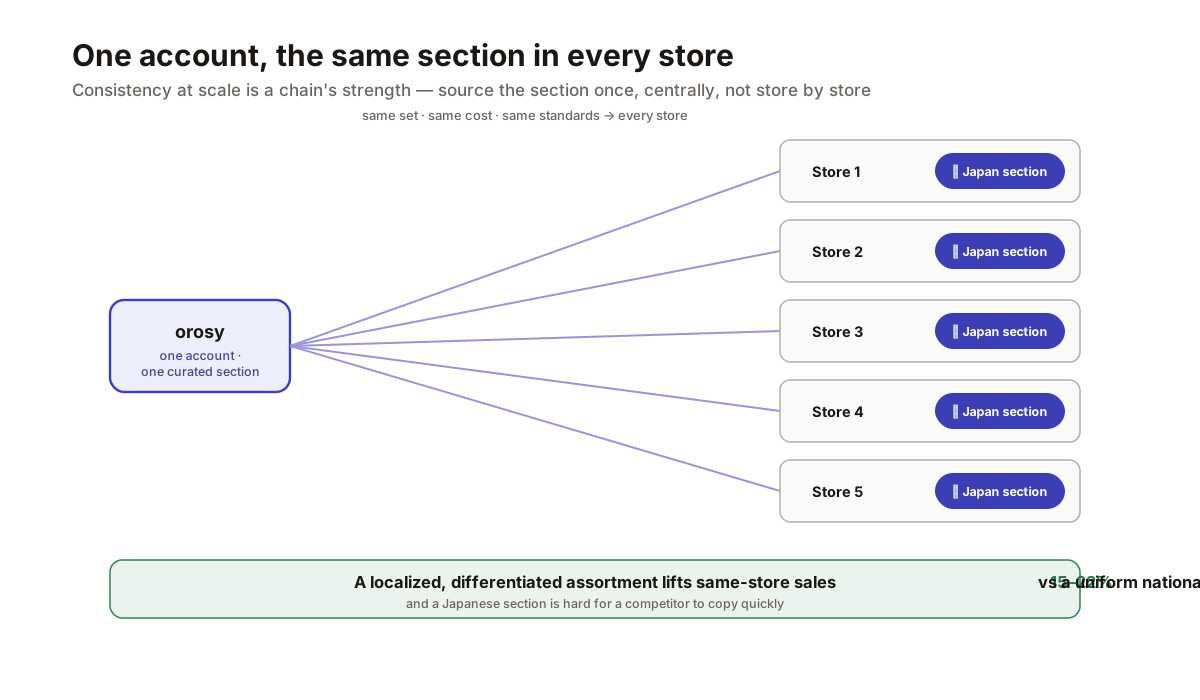
One buying relationship keeps the section consistent across every store — and a differentiated, localized assortment is what lifts same-store sales.
Step 1 — Find the demand in your own data first
You don't have to guess which stores or which category. Your POS and loyalty data already show where Japanese or adjacent product over-indexes, which stores skew toward the demographics that pull it, and where your assortment is thin against demand. Start there: pick the category and the store cluster the data points to, not a chain-wide hunch.
Step 2 — Source through one buying relationship, not store by store
This is the step that's specific to a chain. The failure mode is letting each store or region improvise its own Japanese sourcing — you get inconsistent assortment, inconsistent pricing, and a replenishment mess. The move is the opposite: source the whole section through one buying relationship, so the same curated set, at the same cost, flows to every store on one PO logic. Consistency across stores is the operational backbone of a chain section, and it starts with a single supply relationship rather than many.
Step 3 — Pilot in a cluster before chain-wide rollout
Don't launch the section across 100 stores on day one. Run it in the store cluster your data flagged, with a tight planogram, for a defined window. A pilot proves the section sells, surfaces the merchandising and replenishment kinks while they're cheap to fix, and gives you real comp data to justify the chain-wide rollout. Expand on the pilot's numbers, not on enthusiasm.
Step 4 — Plan replenishment at chain scale
A section that stocks out across a chain erodes the comp lift you built it for. The new variable versus a domestic line is the longer replenishment lead time on Japanese supply, multiplied across every store. Build reorder triggers that account for that lead time and your store count, so winners don't go empty while the next shipment crosses the Pacific. This is ordinary chain replenishment discipline with one extra lead-time input.
Step 5 — Model landed cost so chain pricing holds
Chain pricing is set centrally and has to hold across stores, so model the full landed cost before you set it. Under the 2025 US–Japan framework, most Japanese consumer goods land at roughly 15%, inclusive of the MFN rate rather than added to it, with the exact figure set by each product's HTS classification — so it varies by item, and a few categories sit higher. Duties are ad valorem, so the rate holds at any volume. (Congressional Research Service, Federal Register notice) Whether you owe duties directly depends on your route; our customs, duties, and logistics walkthrough shows how to build the per-SKU landed figure your central pricing can stand on.
Step 6 — Merchandise consistently, measure the comp, then widen
Roll the proven planogram out consistently — same set, same story, same standards — so a shopper gets the same section in every store. Equip the floor with the maker's story so staff can sell it, track same-store sales on the section against your control stores, and widen into the next category or store tier on that comp data. The discipline is your normal category management; the section just gives you a differentiated lever to manage.
③ Three common ways this goes wrong
Do this
- Source the section through one buying relationship so assortment and pricing stay consistent across every store.
- Pilot in a data-chosen store cluster, then roll out on the comp numbers.
- Plan replenishment for the longer Japanese lead time times your store count, so winners don't stock out chain-wide.
Avoid this
- Going chain-wide before piloting. A 100-store launch that misses spreads the mistake across the whole chain instead of one cluster.
- Letting stores or regions source the section independently. You get inconsistent assortment, pricing drift, and a replenishment mess — the opposite of a chain advantage.
- Treating 'Japan' as signage rather than a chosen assortment. A themed end-cap with ten SKUs reads as a gimmick; a curated, well-stocked section reads as a reason to shop your stores.
The middle failure mode is the costly one for a chain. A chain's strength is consistency at scale; a Japanese section sourced ad hoc store by store throws that strength away — different shelves, different prices, no clean read on what's working. Source it once, centrally, and the section inherits the operational discipline that makes your chain a chain.
orosy — the Buyer Portal
If you'd rather add the section than build an import desk, this is the gap orosy is built to fill. The name comes from the Japanese word orosu (卸す), "to wholesale." Founded in 2018, orosy connects buyers to a wide breadth of Japanese supply — 5,000+ Japanese brands and suppliers, about 200,000 products, and 20,000+ buyers — so your Japanese section isn't bounded by one importer's shortlist; you can curate it from nearly the full range of what Japan makes, through one account that supplies every store consistently instead of one contract per brand, and orosy arranges the international shipping to your country. You do not need a forwarder or a receiving point in Japan.
Central pricing needs the full landed figure, so name both costs up front. Before you order, the cart shows a reference figure for international shipping, for your information only. The actual shipping cost is calculated later and billed to you, and it can differ from that figure. Customs clearance in your country, import duties, and taxes at import are your responsibility. They are not part of the cost billed by orosy. Delivery to a receiving point inside Japan also remains available. It's one buying relationship for a section that reaches across your whole chain, instead of a sourcing operation you'd have to build.
FAQ
Why add a Japanese section to a retail chain?
Assortment differentiation. When your shelves carry the same lines as every competitor, the fight is price; a differentiated, localized assortment is one of the few levers that lifts same-store sales without a price war — chains that localize a meaningful share of their range see 15–22% higher comps than uniform-national formats. A Japanese section is a clean, hard-to-copy way to add one, because the supply takes real sourcing work to assemble.
How do I roll a Japanese section out consistently across many stores?
Source it through one buying relationship rather than letting stores or regions improvise. One account supplying the same curated set at the same cost to every store keeps assortment and pricing consistent — the operational backbone of a chain section. Then pilot in a store cluster, prove the comp lift, and roll the proven planogram out chain-wide.
Should I launch chain-wide or pilot first?
Pilot. Run the section in the store cluster your POS and loyalty data flag, with a tight planogram, for a defined window. A pilot proves it sells, surfaces merchandising and replenishment kinks while they're cheap to fix, and gives you real comp data to justify the full rollout — far safer than launching across 100 stores on a hunch.
How do I keep a Japanese section in stock across a chain?
Plan replenishment for the longer Japanese lead time multiplied by your store count. The main difference from a domestic line is international replenishment time, so build reorder triggers that account for it so winners don't go empty chain-wide while the next shipment is in transit. It's ordinary chain replenishment discipline with one extra lead-time input.
How does orosy fit a retail chain's buying?
As one buying relationship for the whole section. orosy connects you to a broad breadth of Japanese supply — 5,000+ brands and about 200,000 products — supplies it consistently through one account, and arranges the international shipping. Before you order, the cart shows a reference figure for international shipping, for your information only. The actual shipping cost is calculated later and billed to you, and it can differ from that figure. Customs clearance, import duties, and taxes at import are yours, and are not part of what orosy bills. Your category and store teams keep what's theirs — choosing the assortment, pricing, planograms — while the section reaches every store through a single account instead of a sourcing operation you'd build.
Sources
- Optimizing Product Assortment Strategies for Retail 2026 (localized assortment & same-store sales), Retailgators: https://www.retailgators.com/optimizing-product-assortment-strategies-retail-2026.php
- Who's Winning Grocery Growth: Chains vs. Specialty Stores (differentiation via exclusive SKUs & local sourcing), FoodNavigator-USA: https://www.foodnavigator-usa.com/Article/2026/03/06/whos-winning-grocery-growth-chains-vs-specialty-stores/
- Japan's Food Exports Rise to ¥1.7 Trillion in 2025 (US top destination, +13.7%), Nippon.com (MAFF data): https://www.nippon.com/en/japan-data/h02696/
- US Tariffs and the 2025 US–Japan Framework Agreement, Congressional Research Service: https://www.congress.gov/crs-product/IN12608
- Implementing Certain Tariff-Related Elements of the United States–Japan Agreement, Federal Register: https://www.federalregister.gov/documents/2025/09/16/2025-17908/implementing-certain-tariff-related-elements-of-the-united-states-japan-agreement