Quick answer: US kitchen and home buyers can bring Japanese product into their assortment across four broad subcategories — knives and metalware, ceramics and lacquerware, cooking appliances, and storage and household goods. The category rewards research because two things vary far more than buyers expect: import duty rates (porcelain tableware is taxed well above the headline 15% framework rate, while other items land near 15%) and product compliance (Japanese-domestic cooking appliances run on 100V and are labeled for Japan, raising voltage and safety-listing questions). This guide maps the subcategories, gives you the honest cost picture, flags the appliance voltage issue, and points to the sourcing routes that fit each one.
Key takeaways
- US demand for Japanese kitchen and home goods spans knives, cast iron, ceramics, and small cooking appliances — each a distinct sourcing problem, not one category.
- The home & kitchen category is unusually tariff-uneven: porcelain tableware carries a much higher import duty than most consumer goods, and the 2025 framework does not bring it down to 15%.
- Because duty rates swing widely within this single category, classifying each product by its HTS code before you commit is essential to an honest landed-cost model.
- Cooking appliances add a separate constraint: Japanese-domestic models are built for 100V and are labeled for use in Japan, so voltage and safety-listing questions belong in your sourcing plan early.
- The region-of-origin stories (Tsubame-Sanjo metalware, Arita porcelain) are real supply facts worth understanding — they tell you where the makers actually are and why the supply base is fragmented.
The demand is real — and it's several markets, not one
If you buy for a kitchenware store, a home-goods chain, or a distributor serving them, you have probably already felt the pull toward Japanese product. The clearest signal is in cutlery: Japanese knife exports rose from 2.5 billion yen in 2000 to a record 11.8 billion yen in 2021 — more than a 370% increase — and some Japanese makers now report that around 80% of their revenue comes from the US market. (KIREAJI market overview) The global kitchen-knife market was valued at roughly USD 2.11 billion in 2025, with the US holding the largest single share, about 21% in 2024. (Fortune Business Insights — kitchen knife market)
But "Japanese kitchen goods" is not one buying decision. A santoku knife, an enameled cast-iron pot, a hand-painted porcelain bowl, and a rice cooker are four different sourcing problems — different makers, different regions, different duty rates, and in the case of appliances, different compliance questions entirely. The mistake buyers make is treating the category as a single line item. The work is in seeing it as a map.
The subcategory map
Here is how the category actually breaks down, with the supply realities behind each piece. The producing-region stories are not decoration — they tell you where the makers physically are and why this supply base is so fragmented and hard to reach from overseas.
Knives and metalware
This is the anchor of the category for most US buyers. Japanese-style kitchen knives are typically lighter, thinner-bladed, and taken to a finer edge than Western counterparts, and are prized for precision slicing. (Fortune Business Insights)
Much of this metalware comes from one concentrated area: Tsubame-Sanjo, two neighboring cities (Tsubame and Sanjo) in Niigata Prefecture with a metalworking culture dating to the Edo period, when farmers hand-forged nails and tools through the winter months. Sanjo specializes in knives, blades, and tools; Tsubame in cutlery, copperware, and fine finishing. The region is reported to account for the large majority of Japan's tableware-metal output, and its cutlery has been used at settings as varied as the Nobel Banquet. (Pearl Life — Tsubame-Sanjo, Suiyoubi — what is Tsubame-Sanjo) Cast iron — teapots and cookware — is a related metalware line with its own regional makers. Knives, scissors, and kitchen tools generally sit at moderate duty rates; the exact figure depends on classification (more on this below).
Ceramics and lacquerware
Tableware is the second pillar — and the most important one to understand on cost, because it is where the duty math gets sharp.
Japan's porcelain heartland is Arita, in Saga Prefecture (Kyushu), where porcelain has been made for over 400 years, since the early 17th century when porcelain stone was discovered nearby. Arita ware has a pure-white base and painted decoration, and was exported to Europe through the Dutch East India Company from 1659. (Arita ware — Wikipedia, KOGEI JAPAN — Imari/Arita) Neighboring Hasami ware grew up alongside it as everyday tableware rather than luxury display — which is exactly the kind of practical, sellable product many US buyers are looking for. (Japan Classic — Arita ware regions)
The category also includes lacquerware (urushi) and stoneware. The crucial buying distinction here is technical, not aesthetic: porcelain ("china") and non-porcelain ceramic are classified differently for customs and taxed at very different rates. That distinction is the single most expensive detail in this entire guide, and it gets its own cost section below.
Cooking appliances
Rice cookers, kettles, and other small kitchen electronics are a high-interest line — brands like Zojirushi and Tiger are well known to US consumers as market facts. But this subcategory carries a constraint the others don't: electrical compatibility. Japanese-domestic appliances are built for 100V mains and are commonly labeled "for use in Japan only." (FlyerTalk — Japan/US appliance compatibility) That makes voltage and safety-listing a sourcing question you have to answer up front, not a detail to discover after the container lands. We treat it as its own section below because it changes how you source this subcategory.
Storage and household goods
The long tail — bento boxes, food storage, kitchen organizers, cleaning tools, and home sundries — is where assortment breadth lives. Individually low-ticket, collectively a meaningful part of a Japanese home section, and generally lower-friction on both duty and compliance than appliances. This is often where buyers round out a Japanese set once the anchor categories are in place.
The honest cost story: this category's tariffs vary more than most
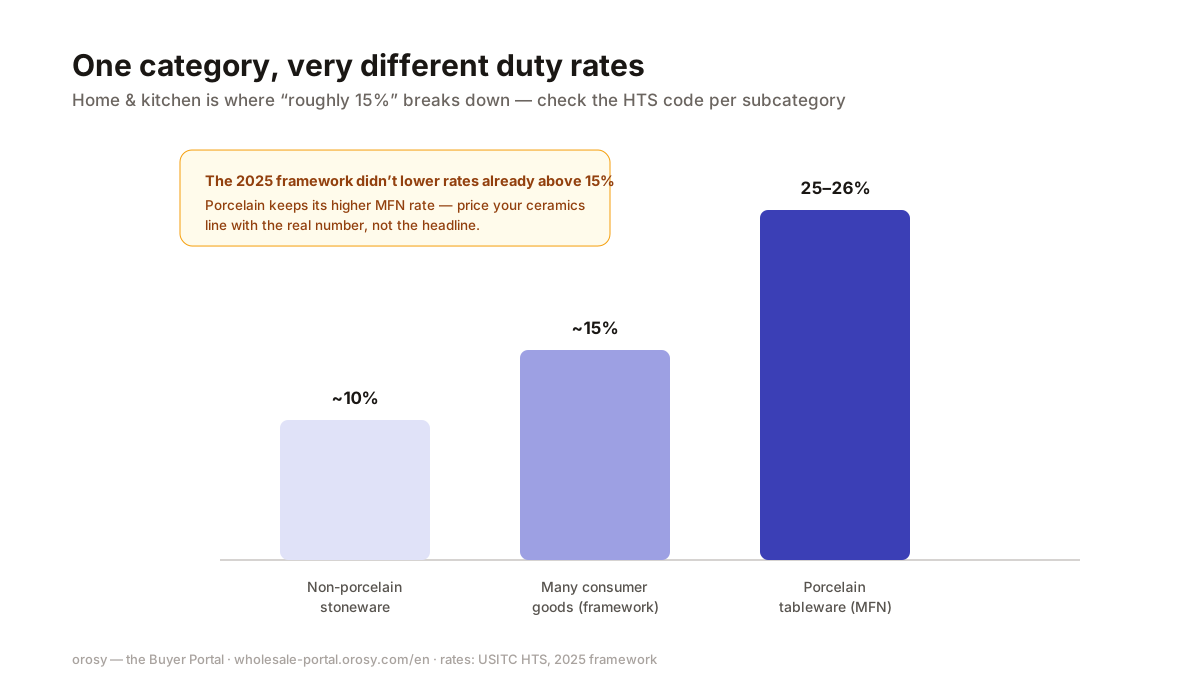
One category, very different duty rates — price each subcategory with its real HTS number.
Here is the part of Japanese home & kitchen sourcing that catches buyers off guard, so we'll be direct about it.
Under the 2025 US–Japan framework agreement, most Japanese consumer goods are tariffed at roughly 15% — and importantly, that 15% is inclusive of the pre-existing most-favored-nation (MFN) rate, not stacked on top of it. For categories whose MFN rate was below 15%, the rate is aligned up to 15%; for categories whose MFN rate was already above 15%, the framework adds nothing and the existing higher rate simply stays in place. (Congressional Research Service, White House — implementing the US–Japan agreement)
That second case is exactly what bites this category. Porcelain ("china") tableware carries an MFN duty rate in the range of about 25–26%, and the 2025 framework does not bring it down to 15% — it stays at that higher rate. (USITC ruling — porcelain tableware 6911.10.10, USITC ruling — 6911.10.35) If you are buying hand-painted Arita porcelain dinnerware expecting a 15% landed duty, your model will be off by a wide margin. This is the most important cost fact for a buyer in this category, and we'd rather you hear it here than at the customs broker.
The flip side is that the category is genuinely uneven. Non-porcelain ceramic tableware sits at a lower MFN rate (around 9.8%) and aligns up to roughly 15% under the framework. (Flexport — HS 6912 ceramic tableware) Glass tableware spans a very wide range — some items around 5%, others above 22% — so the outcome under the framework depends entirely on the specific item. (UNIS — HTS 7013 glassware) Knives and metalware sit at moderate rates that vary by exact classification.
The practical takeaway: within this one category, duty rates swing from roughly 9.8% to 26% depending on material and classification. Two bowls that look similar on a shelf can carry very different import costs. That is why HTS classification matters more here than in almost any other consumer category — you cannot model landed cost honestly with a single blended assumption. For the mechanics of how duties, classification, and clearing actually work, see our companion piece on importing Japanese products: customs, duties, and logistics.
US duties are ad valorem, so the percentage is the same whether you import $1,000 or $100,000 of a given item — what varies is the rate per product, not per order size. And in every route, the duty exists; when you buy from a domestic importer it is already inside the price you pay.
A note on cooking appliances: voltage and safety listing
Appliances deserve their own caution because the issue isn't cost — it's whether the product can be sold and used safely in the US at all.
Japanese-domestic rice cookers, kettles, and similar small appliances are engineered for 100V mains and are widely labeled "for use in Japan only." Running a 100V appliance on American household current (nominally 120V) pushes more power and heat through it than it was designed for, which shortens its life and raises safety concerns; imported domestic units also typically lack US safety listing. (FlyerTalk — Japan/US appliance compatibility, Straight Dope — operating a Japanese 100V appliance in the US)
What this means at a high level for a buyer:
- Confirm whether a given model is a Japanese-domestic (100V) unit or a US-market version before sourcing. Some brands sell US-spec variants designed for US voltage and standards; those are the ones built to be sold here.
- Treat safety listing (the kind of nationally recognized testing-lab mark US retailers expect on electrical goods) as a gating requirement, not an afterthought.
- This is where you bring in a compliance or customs specialist — appliance regulation is product-specific and beyond what a sourcing guide should adjudicate. The point is simply to put the question on your checklist before you commit, not after.
For non-electrical kitchen goods — knives, cast iron, ceramics, storage — this constraint doesn't apply, which is one reason those subcategories are easier first steps into Japanese product.
Which sourcing route fits
The home & kitchen category maps onto the same set of sourcing routes available for any Japanese product — US-based importers, trade shows, direct manufacturer contracts, B2B marketplaces, and buying agents — each trading selection against operational load. Knives and ceramics, with their concentrated maker regions, often reward the direct and trade-show routes for buyers building a differentiated assortment, while appliances push you toward sources that can speak to US-spec compliance. For a full, honest comparison of all five routes — what each gives you and what it costs in effort — see our complete guide to sourcing Japanese products wholesale in the US.
orosy — the Buyer Portal
orosy was built for exactly this kind of fragmented, region-by-region category. Instead of being limited to whatever one importer chose to stock, the platform draws on a Japanese marketplace with 5,000+ brands and suppliers and 20,000+ buyers on it. Founded in 2018, orosy carries the negotiations and account opening with each supplier, so a kitchen assortment drawn from a knife workshop, a ceramics maker, and a housewares brand is one cart and one invoice rather than three account applications.
What can ship depends on where you receive the goods, so check that before you plan an assortment. If you receive goods in Japan, at your own warehouse or through a partner, the full catalog of about 200,000 products is available to you. For delivery to the United States, only stationery ships internationally today; kitchen and dining products are not yet available for US delivery. As of September 18, 2026, orosy ships kitchen and dining products to the United Kingdom, EU countries, Canada, Australia, New Zealand, Singapore, Mexico, and several other markets; what ships to your country lists the destinations, with the tax number each one asks for where we have checked it. Once you set your destination country in the catalog, only the products that can ship there are shown, and the range for each country widens over time.
Classification is the part to do carefully here. Before you order, the cart shows a reference figure for international shipping, for your information only. The actual shipping cost is calculated later and billed to you, and it can differ from that figure. Customs clearance in your country, import duties, and taxes at import are your responsibility. They are not part of the cost billed by orosy. That matters more in a category where duty rates swing as widely as this one does, so classify before you commit rather than after the goods are moving.
FAQ
What duty rate should I expect on Japanese tableware?
It depends heavily on the material. Porcelain ("china") tableware carries an MFN duty rate of roughly 25–26%, and the 2025 US–Japan framework does not reduce it — it stays at that higher level rather than dropping to 15%. Non-porcelain ceramic tableware sits lower (around 9.8% MFN) and aligns up to roughly 15% under the framework, and glass tableware ranges widely. Because rates vary this much within one category, you should classify each product by its HTS code before modeling landed cost rather than assuming a single rate.
Can I import Japanese rice cookers and kettles to sell in the US?
You can, but check the electrical spec first. Japanese-domestic appliances are built for 100V and are commonly labeled "for use in Japan only," which raises voltage compatibility and US safety-listing questions. Some brands sell US-market versions designed for US voltage and standards — those are the ones built to be sold here. Treat appliance compliance as a gating question and consult a compliance or customs specialist, since the rules are product-specific.
Where are Japanese knives and porcelain actually made?
Much of Japan's kitchen metalware — knives, blades, and cutlery — comes from Tsubame-Sanjo in Niigata Prefecture, a region with an Edo-period metalworking heritage. Porcelain tableware centers on Arita in Saga Prefecture, where porcelain has been produced for over 400 years, with neighboring Hasami known for everyday tableware. These concentrated maker regions are part of why the supply base is fragmented and harder to reach directly from overseas.
Is the 2025 US–Japan 15% tariff a flat rate for all kitchen goods?
No. The 15% framework rate is inclusive of the existing MFN rate, not added on top of it. Categories below 15% align up to 15%, but categories already above 15% — like porcelain tableware at roughly 25–26% — keep their higher existing rate. Within home & kitchen specifically, duty outcomes range from about 9.8% to 26% depending on material and classification, so a single flat assumption will mislead your cost model.
Sources
- KIREAJI — Japanese knife market and craftsmanship overview (export figures, US revenue share): https://kireaji.ca/pages/why-japanese-knives-captivate-the-world
- Fortune Business Insights — Kitchen Knife Market (market size, US share, product characteristics): https://www.fortunebusinessinsights.com/kitchen-knife-market-103865
- Pearl Life — Why Tsubame-Sanjo Became Japan's Center for Stainless Steel: https://www.pearllife-global.com/blog-posts/2026/1/28/why-tsubame-sanjo-became-japans-center-for-stainless-steel
- Suiyoubi — What Is Tsubame-Sanjo? Japan's Stainless Steel Craft Region Explained: https://suiyoubi.store/blogs/%E3%83%8B%E3%83%A5%E3%83%BC%E3%82%B9/what-is-tsubame-sanjo-japan
- Arita ware — Wikipedia (history, export to Europe): https://en.wikipedia.org/wiki/Arita_ware
- KOGEI JAPAN — Imari Ware / Arita Ware: https://kogeijapan.com/locale/en_US/imariyakiaritayaki/
- Japan Classic — Arita Ware regional characteristics (Hasami as everyday tableware): https://www.japanclassic.shop/blogs/news/vol-2-arita-ware-a-detailed-explanation-of-its-regional-characteristics
- Congressional Research Service — US Tariffs and the 2025 US–Japan Framework Agreement: https://www.congress.gov/crs-product/IN12608
- White House — Implementing the United States–Japan Agreement (MFN-inclusive structure): https://www.whitehouse.gov/presidential-actions/2025/09/implementing-the-united-states-japan-agreement/
- USITC ruling — porcelain tableware HTS 6911.10.10 (~25–26% MFN): http://www.faqs.org/rulings/tariffs/69111010.html
- USITC ruling — porcelain tableware HTS 6911.10.35: http://www.faqs.org/rulings/tariffs/69111035.html
- Flexport — HS 6912 non-porcelain ceramic tableware (~9.8% MFN): https://www.flexport.com/data/hs-code/6912-ceramic-tableware-kitchenware-other-household-articles-and-toilet-articles-other-than-of-porcelain-or-china/
- UNIS — HTS 7013 glassware duty ranges: https://www.unisco.com/hts/70133760
- FlyerTalk — Japan/US appliance electrical compatibility (100V domestic appliances): https://www.flyertalk.com/forum/japan/643365-japan-us-appliances-electrical-compatibility.html
- Straight Dope — operating a Japanese 100V appliance in the US: https://boards.straightdope.com/t/naf-operating-a-japanese-100v-appliance-in-the-us/815407