Quick answer: If you're a regional importer or specialty distributor, you've already solved the hard logistics — you clear customs and move freight today. So the thing capping your Japanese line isn't operations; it's reach. Your selection is bounded by the few Japanese makers you could personally find, contract, and manage, while Japan's actual supply base runs to thousands of makers who sell domestically and never surface through your existing relationships. Demand keeps broadening past what your current suppliers can feed it. The move is to broaden your line through one aggregated source rather than onboarding makers one at a time — using it primarily for reach, and selectively for the cross-border work on the new makers you couldn't otherwise touch. This playbook walks through it.
Key takeaways
- If you already import, your constraint on Japanese product usually isn't customs or freight — you've solved those. It's reach: your line is capped at the handful of Japanese makers you could find, onboard, and manage.
- Demand is outrunning that line. US demand for Asian and Japanese product keeps broadening past immigrant households into mainstream and second-generation buyers — your shelf can sell more Japanese SKUs than your current suppliers can give you.
- Japan's supply base is thousands of makers, most of whom sell domestically and aren't reachable through the relationships you already have. The gap between 'what you carry' and 'what Japan makes' is enormous.
- Broadening by onboarding makers one by one scales with your headcount and stalls on their export-readiness. Reaching breadth through one source scales with an account.
- Because you already run imports, you can use a source primarily for reach — and selectively hand it the cross-border work on the new makers you couldn't otherwise touch.
The situation: demand is broadening faster than your line
If you import Asian grocery, J-beauty, hobby, or specialty Japanese goods, your category is growing. The US Asian food market alone is valued around $38.1 billion in 2025 and projected to reach $52.5 billion by 2032, and the demand base now reaches well beyond first-generation immigrant households into second- and third-generation buyers seeking authentic connection and mainstream shoppers chasing flavor. (US Asian Food Market, Persistence Market Research, US Ethnic Food Market, Future Market Insights) Japanese product specifically rides that wave — Japan's food and agricultural exports hit a record ¥1.70 trillion in 2025 with the US the top destination, up 13.7%; in beauty, North American J-beauty demand is concentrated in the US and led by skincare. (Nippon.com / MAFF data, Future Market Insights — J-beauty)
Here's the mismatch this playbook is about: your buyers want more Japanese SKUs than your current Japanese suppliers can give you. Your line isn't narrow because demand is soft. It's narrow because of how few makers you could reach. This is a playbook for closing that gap without it becoming a sourcing department.
For the full map of routes into Japanese supply, our guide to sourcing Japanese products wholesale in the US covers all five; this piece is specifically for the importer who already has logistics and needs reach.
① Why your Japanese line is narrower than the demand
You didn't choose a narrow Japanese line; the structure of Japan's supply handed it to you.
Japan's supply side is deep and fragmented — thousands of makers and wholesalers who spent decades refining products for the domestic market and sell through long-standing domestic relationships. Exporting was never their channel. So the makers you carry are the small subset that happened to be export-ready, or that you invested months reaching and onboarding. Every addition costs you the same way: find the maker, bridge the language, negotiate terms, set up the relationship. That cost is why your line plateaus — not a lack of good product, and not a lack of demand. The breadth exists; the path to it is what's missing.
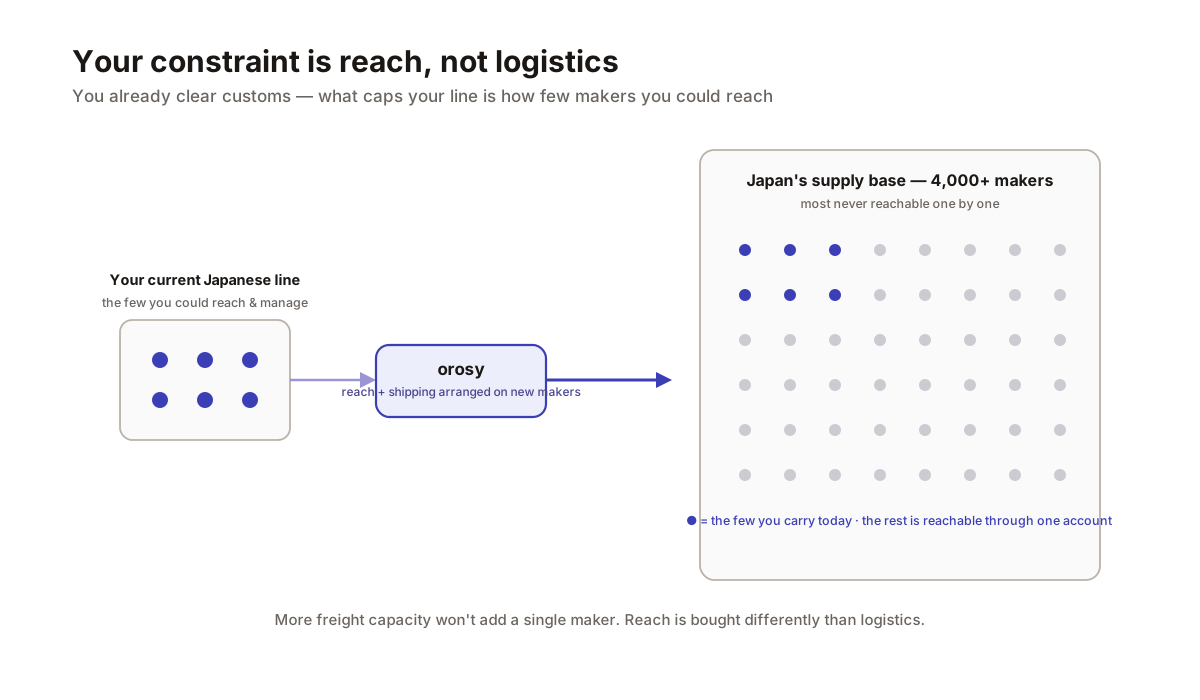
Your constraint isn't logistics — it's the gap between the few makers you could reach and the thousands you couldn't.
② The playbook
Step 1 — Audit your line against what your buyers ask for
Start with the gap you can already see. List your current Japanese SKUs and suppliers, then pull the requests your accounts make that you can't currently fill — the brand a buyer keeps asking for, the category your shelf is thin in. That unfilled-request list is your broadening roadmap, ranked by real demand rather than guesswork.
Step 2 — Name the real constraint: reach, not logistics
This is the reframe the whole playbook turns on. As an importer, you already clear customs and move freight — those aren't your bottleneck. Your bottleneck is reach: the number of Japanese makers you can find, qualify, and onboard. Solving the wrong constraint — buying more logistics capacity, say — won't widen your line. Solving reach will. Be honest with yourself about which problem you actually have, because it changes what you go shopping for.
Step 3 — Broaden through one source, not maker-by-maker
There are two ways to widen the line. Keep onboarding makers individually — which scales with your headcount and keeps stalling on makers who aren't set up to export — or reach breadth through a single aggregated source that already represents thousands of Japanese makers. For an importer who wants depth across many new SKUs, the second is the only path that doesn't turn into a hiring problem. You add an account, not a department.
Step 4 — Decide what to keep in-house
You don't have to hand off everything, and you shouldn't pretend you need to. You already run imports — so use a source primarily for reach: access to makers you couldn't otherwise touch. Then decide, line by line, where it also makes sense to let the source arrange the shipping too — typically on new makers where setting up your own lane isn't worth it for the volume — and where to keep using your own consolidation point in Japan. Keep what your operation does well; outsource the reach you can't build, and the logistics only where it pays.
Step 5 — Model landed cost on the new lines
New SKUs mean new HTS classifications, so re-run the landed-cost math rather than assuming your existing lines' rates carry over. Under the 2025 US–Japan framework, most Japanese consumer goods land at roughly 15%, inclusive of the MFN rate rather than added to it, with the exact figure set by each product's classification — so it varies by item, and a few categories sit higher. Duties are ad valorem, so the rate holds at any volume. (Congressional Research Service, Federal Register notice) If a source carries the import on a new line, duties and freight should pass through transparently; our customs, duties, and logistics walkthrough shows how to keep the per-SKU figure honest.
Step 6 — Test the new lines, then widen on data
Don't widen everywhere at once. Add the highest-demand gaps from Step 1 first, watch sell-through at the account level, prune what doesn't move, and feed the winners back into your next broadening pass. You already run this discipline on the rest of your catalog; the only new variable is the longer replenishment lead time on Japanese supply, which makes reorder timing on the new lines worth managing proactively.
③ Three common ways this goes wrong
Do this
- Name reach as the constraint, and solve it with one aggregated source rather than maker-by-maker onboarding.
- Keep the logistics you run well in-house; hand off cross-border only on new makers where it pays.
- Broaden into the highest-demand gaps first, validated against your buyers' unfilled requests.
Avoid this
- Spending to fix logistics when the real constraint is reach. More freight capacity won't add a single maker to your line.
- Onboarding makers one by one to get depth. It scales with headcount and stalls on export-readiness; you'll widen slowly and burn the team out.
- Widening everywhere at once. A flood of new SKUs you can't read drowns the sell-through signal. Add the demand-backed gaps first, then expand on data.
The first failure mode is the subtle one. Importers are operators by instinct, so when a line feels capped, the reflex is to optimize operations. But you can make your customs and freight flawless and still have a narrow Japanese line, because the limit was never there. The lever is reach — and reach is bought differently than capacity.
orosy — the Buyer Portal
If reach is your constraint, this is the gap orosy is built to fill. The name comes from the Japanese word orosu (卸す), "to wholesale." Founded in 2018, orosy connects buyers to a wide breadth of Japanese supply — 5,000+ Japanese brands and suppliers, about 200,000 products, and 20,000+ buyers — so your Japanese line isn't bounded by the makers you could individually reach; you can broaden across nearly the full range of what Japan makes through one account. The fit is specific: you already run imports, so what you need is reach, plus someone carrying the negotiation and account opening on makers where setting up your own relationship isn't worth the volume.
You can take it either way. orosy arranges the international shipping to your country — you do not need a forwarder or a receiving point in Japan. Before you order, the cart shows a reference figure for international shipping, for your information only. The actual shipping cost is calculated later and billed to you, and it can differ from that figure. Delivery to a receiving point inside Japan also remains available, so since you already run your own lane out of Japan, either fits. Import duties and customs clearance stay yours either way — exactly as they already are. It's not a replacement for the import operation you've built; it's the reach you couldn't build yourself, feeding into it.
FAQ
I already import Japanese products — what would orosy add?
Reach. As an importer you've solved customs and freight; your constraint is the limited number of Japanese makers you could find and onboard. orosy connects you to a broad breadth of Japanese supply — 5,000+ brands and about 200,000 products — so you can widen your line beyond your current suppliers through one account, without opening a relationship with each new maker. orosy can arrange the shipping, or hand over at your existing consolidation point in Japan — import duties and clearance stay yours either way.
Why is my Japanese line narrower than demand?
Because of how few makers you could reach, not soft demand. Japan's supply is thousands of fragmented makers who sell domestically and aren't set up to export, so the ones you carry are the small export-ready subset or the ones you spent months onboarding. The breadth exists; the path to it is what's been missing — which is a reach problem, not a logistics one.
Should I onboard more Japanese makers individually or use one source?
For depth across many new SKUs, one aggregated source. Onboarding makers individually scales with your headcount and keeps stalling on makers who can't export, so you widen slowly. Reaching breadth through a single source scales with an account instead of a hiring plan — you add a line, not a sourcing department.
Do I have to give up my own logistics to broaden my line?
No. You already run imports well, so keep that. Use a source primarily for reach to makers you couldn't otherwise touch, and hand off the cross-border work selectively — typically only on new makers where setting up your own export relationship isn't worth the volume. Keep what you do well; outsource the reach you can't build.
How does orosy fit an existing import operation?
As the reach layer on top of it. orosy connects you to a broad breadth of Japanese supply — 5,000+ brands and about 200,000 products — and carries the negotiation and account opening on makers you would otherwise approach yourself. orosy arranges the international shipping to your country. Before you order, the cart shows a reference figure for international shipping, for your information only. The actual shipping cost is calculated later and billed to you, and it can differ from that figure. Customs clearance, import duties, and taxes at import are yours, and are not part of what orosy bills. You keep your existing lines and logistics; orosy adds the makers you couldn't reach, so your line grows with demand instead of plateauing at the suppliers you could personally manage.
Sources
- US Asian Food Market Size & Growth ($38.1B 2025 → $52.5B 2032), Persistence Market Research: https://www.persistencemarketresearch.com/market-research/us-asian-food-market.asp
- United States Ethnic Food Market (demand broadening beyond immigrant households), Future Market Insights: https://www.futuremarketinsights.com/reports/united-states-ethnic-food-market
- Japan's Food Exports Rise to ¥1.7 Trillion in 2025 (US top destination, +13.7%), Nippon.com (MAFF data): https://www.nippon.com/en/japan-data/h02696/
- J-Beauty Product Market Size & Industry Trends, Future Market Insights: https://www.futuremarketinsights.com/reports/j-beauty-product-market
- US Tariffs and the 2025 US–Japan Framework Agreement, Congressional Research Service: https://www.congress.gov/crs-product/IN12608
- Implementing Certain Tariff-Related Elements of the United States–Japan Agreement, Federal Register: https://www.federalregister.gov/documents/2025/09/16/2025-17908/implementing-certain-tariff-related-elements-of-the-united-states-japan-agreement