Quick answer: Adding Japanese supply to a B2B marketplace is a catalog-differentiation play, and it works best when you treat it as an integration problem, not a sourcing-by-hand problem. Most platforms can't easily carry a Japanese line because Japan's supply is spread across thousands of makers who sell domestically and aren't set up to export — onboarding them one by one means repeating language, contract, and customs work for each. The move is to plug into one aggregated Japanese supply source through a single integration, let that source carry the supplier relationships and arrange the shipping, settle who is the importer of record, validate which categories your buyers want first, and merchandise the line with the maker's story. This playbook walks through that sequence.
Key takeaways
- Japanese supply is a differentiator a competing marketplace can't quickly copy — most B2B platforms don't carry a real Japanese line, so it widens your catalog into space others aren't in.
- The trap is onboarding makers one by one. Japan's supply is fragmented across thousands of makers and wholesalers (wholesalers); integrating them individually means N language barriers, N contracts, and N customs problems.
- One integration beats N onboardings. Plugging into a single aggregated Japanese supply source collapses that work into one connector — the lever this playbook is built around.
- Cross-border is the part a marketplace usually can't carry. Customs, duties, and international freight have to be handled by the supply source, not bolted onto your platform.
- Validate which categories your buyers actually want before you integrate anything — your platform already has the demand signal in its search and request data.
The situation: your buyers want variety you can't easily add
B2B marketplaces are multiplying — the count has grown from roughly 75 platforms five years ago to over 750 industry-specific marketplaces today, with projections of around 1,000 by 2026, and the segment is growing faster than B2B e-commerce overall. (B2B marketplace trends, Swell) In a field that crowded, the platforms that win are the ones whose catalog a buyer can't get everywhere else.
That's the strategic case for Japanese supply. A marketplace's job is to aggregate supply a single seller can't replicate and give buyers variety they can't assemble themselves. Japanese product — stationery, J-beauty, snacks, kitchenware, design goods — is exactly the kind of high-pull, hard-to-source supply that does that. The catch is operational: it's hard to add precisely because it's hard to source, and that difficulty is what makes it defensible once you've solved it.
This is a practical playbook for adding that line to your platform without drowning your operations team in supplier onboarding. It assumes you run a real marketplace or B2B catalog — buyers, sellers, an integration layer — and works inside that reality. For the broader map of how Japanese product reaches the US at all, our guide to sourcing Japanese products wholesale in the US covers every route; this piece is about doing it at platform scale.
① Why Japanese supply, specifically
A Japanese line only earns catalog space if there's pull behind it. The demand signal is clear in what's already crossing the border.
Japan's agricultural and food exports rose 12.8% year on year to a record ¥1.70 trillion in 2025, and the United States was the top destination at ¥276.2 billion, up 13.7%. (Nippon.com / MAFF data) J-beauty tells the same story: North American demand is concentrated in the US, with skincare the largest slice, driven by the minimalist routines younger shoppers favor. (Future Market Insights — J-beauty) Read these as direction and durability of demand — enough to justify a tested, disciplined entry, not a guaranteed attach rate on your platform.
What makes this supply distinctive is also what makes it defensible: many of the strongest Japanese makers have spent decades refining products for a demanding domestic market and sell through long-standing domestic relationships. Their catalogs are world-class; the reason they're hard to reach isn't quality, it's that the routes to find them were built for Japan, not for an overseas platform. A competitor can copy your UI in a quarter. They can't copy a Japanese supply base that took years of relationships to assemble.
② The playbook
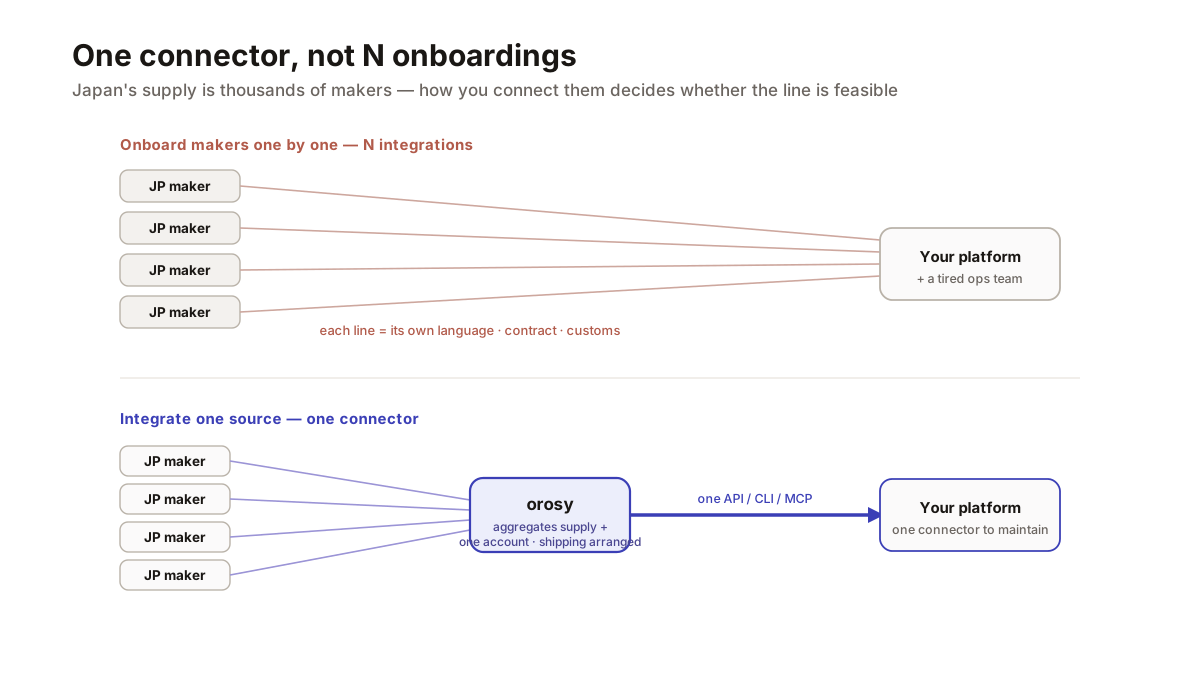
Onboarding makers one by one means N integrations and N customs problems. One aggregated source collapses it to a single connector.
Step 1 — Read demand from your own platform data first
Don't start by evaluating Japanese suppliers. Start with the demand signal you already own. Your platform records what buyers search for, request, and abandon. Pull the queries and unfilled requests that point at Japanese product or the categories it lives in — beauty, stationery, snacks, homeware. That tells you whether the pull is real on your platform specifically, and which category leads, before you integrate anything.
Step 2 — Decide: onboard makers, or integrate one source
This is the decision the whole program turns on. You can add Japanese supply two ways:
- Onboard makers individually. Each Japanese maker becomes a seller you contract, translate, and support — and each brings its own export readiness problem (most aren't set up to export at all). For a deep selection, that's dozens to hundreds of onboardings, each with language, contract, and customs friction.
- Integrate one aggregated source. Plug into a single supply source that already represents a broad breadth of Japanese makers, and reach all of it through one connector. You trade some direct-relationship control for collapsing N onboardings into one integration.
For most platforms, the second is the only realistic path to a deep Japanese line on a sane timeline. The first scales linearly with headcount; the second scales with one integration.
Step 3 — Choose your integration surface
Once you've decided to integrate a source, match the integration to how your platform builds. A modern supply source should meet your team where it works — a REST API for your engineers to pull catalog and push orders, a feed/CLI for batch sync, or an agent/MCP path if your catalog ops are AI-assisted. The point is that adding Japanese supply becomes a connector you maintain, not a procurement team you staff.
Step 4 — Settle who carries customs and freight
This is the step platforms most often get wrong, because it's invisible until an order fails. A marketplace's software can route an order, but it can't clear customs or move a pallet across the Pacific. The cross-border operation — duties, customs clearance, international freight — has to be carried by the supply source, not bolted onto your platform. Before you integrate, confirm exactly who is the importer of record and how duties and freight are billed.
The economics are tractable once you know the rule: under the 2025 US–Japan framework, most Japanese consumer goods are tariffed at roughly 15%, inclusive of the pre-existing MFN rate rather than stacked on top of it, with the exact figure set by each product's HTS classification — so it varies by category, not one flat number. Duties are ad valorem, so the rate is the same at sample or container scale. (Congressional Research Service, Federal Register notice) Our walkthrough of importing Japanese products: customs, duties, and logistics breaks down how that lands in a per-order cost — read it so your take-rate math holds.
Step 5 — Merchandise the line, with the maker's story
A Japanese line listed as bare SKUs converts worse than it should. Two things lift it. First, clean catalog data — accurate pack sizes, case quantities, and landed pricing your buyers can act on. Second — the part platforms skip — the maker's story. A product carrying decades of craft refinement gives the buyer a reason-to-buy a generic listing doesn't, and gives their customer a story too. Surface who makes it and what they're known for in Japan, not just a price.
Step 6 — Measure attach, then widen
A new line isn't a success when it's live — it's a success when buyers attach it to their orders and come back. Track attach rate and GMV on the Japanese line at the category level, watch which SKUs move, and widen into the next category your data points to. The discipline is the same that runs the rest of your catalog; the new variable is the longer replenishment lead time on Japanese supply, which makes inventory and reorder signals worth surfacing to your sellers proactively.
③ Three common ways this goes wrong
Do this
- Integrate one aggregated Japanese source through a single connector, with cross-border customs and freight carried by that source.
- Validate the category against your own platform's search and request data before integrating.
- Merchandise on product quality and the maker's story — durable reasons buyers attach the line.
Avoid this
- Onboarding Japanese makers one by one. It scales with headcount, stalls on export-readiness, and you'll have a thin line and a tired ops team. Integrate a source instead.
- Listing Japanese SKUs without settling who clears customs and freight. Orders that can't be fulfilled across the border are worse than no listing at all.
- Treating 'Japan' as a marketing banner rather than real supply. A Japan tab with ten SKUs and no depth reads as a gimmick; depth in one category reads as a catalog.
The second failure mode is the expensive one. It's easy to list product and discover the cross-border operation only when a buyer's order can't ship. Settle the importer-of-record and the duty/freight billing before a single Japanese SKU goes live — it's the difference between a line that fulfills and a support queue.
orosy — the Buyer Portal
If you'd rather integrate one source than onboard hundreds of makers, this is the gap orosy is built to fill. The name comes from the Japanese word orosu (卸す), "to wholesale." Founded in 2018, orosy connects buyers to a wide breadth of Japanese supply — 5,000+ Japanese brands and suppliers, about 200,000 products, and 20,000+ buyers — and is now an equity-method affiliate of giftee Inc. (Tokyo Stock Exchange Prime: 4449). For a platform, that means your Japanese line isn't bounded by which makers you could individually onboard; you reach across a broad range of what Japan makes through one integration — a REST API, CLI, MCP server, or agent path — instead of repeating the language, contract, and account-opening work for every maker. orosy arranges the international shipping to whoever places the order. You do not need a forwarder or a receiving point in Japan.
Surface both cross-border costs in your own checkout rather than absorbing them. Before you order, the cart shows a reference figure for international shipping, for your information only. The actual shipping cost is calculated later and billed to you, and it can differ from that figure. Customs clearance in your country, import duties, and taxes at import are your responsibility. They are not part of the cost billed by orosy. Model your take-rate on top of that, so your buyers' landed cost is a figure they can see.
FAQ
Should a B2B marketplace onboard Japanese makers individually or integrate one source?
For a deep line on a realistic timeline, integrate one aggregated source. Onboarding makers individually scales with headcount and stalls on export-readiness — most Japanese makers sell domestically and aren't set up to export — so you repeat language, contract, and customs work for each. One integration collapses that into a single connector you maintain.
Who arranges shipping, and who clears customs, when a marketplace adds Japanese supply?
The supply source should arrange the shipping; the platform shouldn't try to. A marketplace can route an order but isn't set up to move freight out of Japan. Customs is a separate question with a separate answer: it belongs to whoever is the importer of record. Before integrating, settle both in writing — who arranges the shipment, who imports, and how the shipping cost is set and billed — because an order that can't ship across the border is worse than no listing.
How do I add Japanese products to my platform technically?
Through a connector to a supply source rather than a procurement team. A modern source should offer a REST API to pull catalog and push orders, plus batch/CLI or agent (MCP) paths, so adding Japanese supply is an integration your engineers maintain — catalog sync and order flow into your existing systems — not a set of manual supplier relationships.
Why is Japanese supply hard for a competing marketplace to copy?
The supply isn't sitting in an easy-to-onboard channel. Japan's strongest makers sell through long-standing domestic relationships and largely don't export, so assembling a deep, curated selection takes real sourcing work and relationships built over years. A competitor can copy your interface quickly; they can't quickly copy a Japanese supply base, which is what makes the line defensible.
How does orosy fit a marketplace's stack?
orosy is the supply layer. It connects you to a broad breadth of Japanese supply — 5,000+ brands and about 200,000 products — through one integration (REST API, CLI, MCP, or agent), with the supplier relationships carried by orosy and the international shipping arranged. Before you order, the cart shows a reference figure for international shipping, for your information only. The actual shipping cost is calculated later and billed to you, and it can differ from that figure. Customs clearance, import duties, and taxes at import belong to the importer, and are not part of what orosy bills. Your platform keeps the parts that are yours — buyers, merchandising, checkout — and reaches Japan through a single connector instead of hundreds of onboardings.
Sources
- B2B Marketplace Trends Shaping Digital Wholesale Commerce (75→750+ platforms, ~1,000 by 2026), Swell: https://www.swell.is/content/b2b-marketplace-trends-shaping
- Global B2B E-Commerce Market Size & Growth, Mordor Intelligence: https://www.mordorintelligence.com/industry-reports/global-b2b-ecommerce-market
- Japan's Food Exports Rise to ¥1.7 Trillion in 2025 (US top destination, +13.7%), Nippon.com (MAFF data): https://www.nippon.com/en/japan-data/h02696/
- J-Beauty Product Market Size & Industry Trends, Future Market Insights: https://www.futuremarketinsights.com/reports/j-beauty-product-market
- US Tariffs and the 2025 US–Japan Framework Agreement, Congressional Research Service: https://www.congress.gov/crs-product/IN12608
- Implementing Certain Tariff-Related Elements of the United States–Japan Agreement, Federal Register: https://www.federalregister.gov/documents/2025/09/16/2025-17908/implementing-certain-tariff-related-elements-of-the-united-states-japan-agreement