Quick answer: For an independent sales rep or agency, adding a Japanese line to your card is a differentiation play — a line none of your competitors carry makes every account call worth more, because you're offering something they can't get elsewhere. The reason most reps don't carry one is that Japanese supply is hard to reach and you're built to sell, not to import. The fit is a clean division of labor: you keep what's yours — the territory, the relationships, the close — and a source holds the Japanese supplier relationships and arranges the shipping, so it's orders in, deliveries out. Validate the line against your own accounts, insist on reliable fulfillment because your reputation rides on it, and price it on a real cost basis. This playbook walks through it.
Key takeaways
- Your card is your business. A line no competing rep carries is worth more per call — it differentiates your card instead of duplicating the lines every other rep already pitches.
- A Japanese line is exactly that kind of differentiated addition — and most reps can't add one, because the supply is hard to reach and you're a sales function, not an importer.
- You don't have to become an importer to carry it. The model that fits a rep is a clean division of labor: you sell into your accounts; a source holds the Japanese supplier relationships and arranges the shipping — orders in, deliveries out.
- Reliable fulfillment is non-negotiable for a rep. Your accounts are your reputation, so a Japanese line is only worth adding if it ships dependably — a missed delivery costs you the relationship, not just the order.
- Read your accounts for the gap first. You already know which of your buyers would take a Japanese line; that's your validation before you add anything.
The situation: your card is your business
As an independent rep, your card is your business — the group of complementary lines you carry into a territory, sold on commission, often several on the same call. Your value to your principals is your relationships; your value to your accounts is a set of lines that solves their needs. So the lines you carry decide what you're worth. (What is a Manufacturers Representative, Wave Reps, How manufacturers reps are paid, RepHunter)
The pressure is that most lines on offer are lines every other rep can also pitch. Reps are always hunting for the next line to add — there are whole marketplaces for finding them — but a line that actually differentiates your card, that your competitor down the hall can't offer, is rare. A Japanese line is one of those, and this is a playbook for adding it without stepping outside what a rep does.
For the broader supply-side map, our guide to sourcing Japanese products wholesale in the US covers the routes; this piece is about carrying a Japanese line as a rep specifically.
① Why a Japanese line is a strong addition to a rep's card
Two reasons, and they map to how a rep actually earns.
It differentiates your card. A rep's leverage is selling more per call. A line no competing rep carries gives your accounts a reason to take your call — and gives you something to sell alongside your existing lines rather than fighting another rep over the same one. Differentiation on the card is differentiation in your commission.
It's a real, current category. Japanese product has strong, growing US pull — Japan's food and agricultural exports hit a record ¥1.70 trillion in 2025 with the US the top destination, up 13.7%. (Nippon.com / MAFF data) So a Japanese line isn't a curiosity you have to talk your accounts into; it's a category your buyers are already aware their customers want.
② The playbook
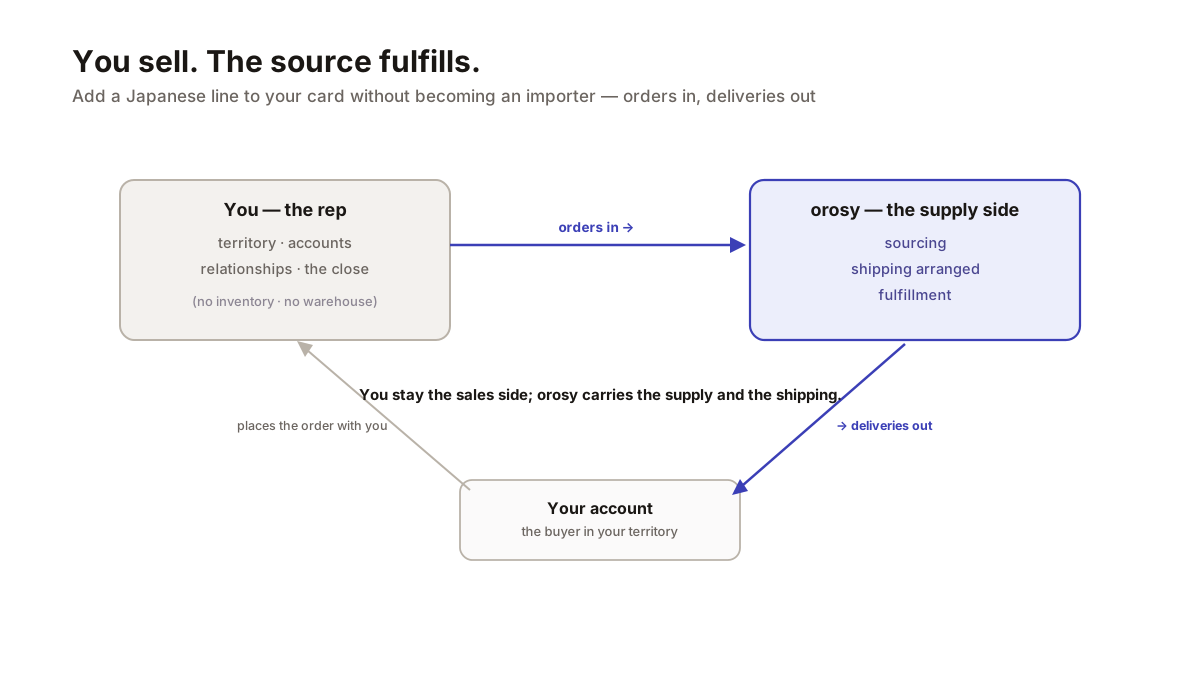
A rep sells; the source fulfills. Orders in, deliveries out — you add a Japanese line without becoming an importer.
Step 1 — Read your accounts for the gap first
You have validation most line-additions never get: you already know your buyers. Before adding anything, run your top accounts in your head (or on a quick call): which of them would take a Japanese line, in which category, at what price point. That tells you whether the line will actually move in your territory before you commit to representing it — and which accounts you'll open it with.
Step 2 — Stay a sales function: you sell, you don't operate
This is the reframe a rep has to get right. You're a 1099 sales business — your edge is relationships and selling, and you keep yourself lean by not carrying inventory, staff, or operations. A Japanese line that asked you to import, clear customs, and warehouse would break that model. So the only version of this worth doing is one where you stay purely the sales side and someone else carries the operation. Don't let a new line turn you into an importer.
Step 3 — Add the line through one source that fulfills
The fit is a clean division of labor. You represent the Japanese line to your accounts; a single source holds the Japanese supplier relationships and arranges the shipping behind you — your account orders, the product ships, you didn't touch a pallet. "Orders in, deliveries out" is the whole arrangement. You add a differentiated line to your card and gain a new commission stream without adding an operation to run.
Step 4 — Protect your accounts: insist on reliable fulfillment
For a rep, this is the one that matters most, because your accounts are your reputation. A line that ships late or wrong doesn't just cost an order — it costs the trust you've spent years building, and your accounts hold you responsible regardless of who dropped the ball. So vet fulfillment before you put the line in front of a single buyer: who clears customs, who guarantees the delivery window, what happens when something slips. A Japanese line is only worth carrying if it ships as dependably as the lines you already trust your name to.
Step 5 — Know the economics so you can quote straight
You're not the importer, but you still need to understand the cost basis to quote your accounts honestly and protect your commission. The relevant rule: under the 2025 US–Japan framework, most Japanese consumer goods are tariffed at roughly 15%, inclusive of the MFN rate rather than added to it, with the exact figure set by each product's classification — so it varies by item. Duties are ad valorem, so the rate holds at any size. (Congressional Research Service, Federal Register notice) When a source carries the import, those costs should pass through transparently so your landed pricing — and your commission on it — is predictable. Our customs, duties, and logistics walkthrough shows how that cost is built.
Step 6 — Pitch the maker's story, then widen across accounts
Lead your pitch with the maker's story — it's a reason-to-buy your accounts can carry to their own customers, and it's what makes a differentiated line easy to open. Start with the accounts from Step 1, watch which take it and reorder, and widen across your territory on that signal. The line compounds the way the rest of your card does: each account that adds it is recurring commission on something only you, in your territory, are offering.
③ Three common ways this goes wrong
Do this
- Keep yourself a pure sales function — represent the line, let a source carry the supplier relationships and the shipping arrangement.
- Vet fulfillment reliability before you put the line in front of an account, because your reputation rides on it.
- Validate against your own accounts and open with the ones the line clearly fits.
Avoid this
- Letting a new line turn you into an importer. Carrying inventory, customs, and freight breaks the lean 1099 model your business runs on.
- Putting an unproven-fulfillment line in front of a key account. A missed delivery on a line you introduced costs you the relationship, not just the order.
- Adding 'Japan' as a label rather than a genuinely good line. Your accounts trust your judgment; a gimmicky line spends that trust. Carry product that's actually strong.
The second failure mode is the one that's uniquely expensive for a rep. A distributor who has a fulfillment problem loses an order; a rep who introduces a line that fails loses the account's confidence in everything else on the card. Your name is on the introduction. So the reliability of the line isn't a nice-to-have — it's the precondition for carrying it at all.
orosy — the Buyer Portal
If you want to represent a Japanese line without becoming an importer, this is the gap orosy is built to fill. The name comes from the Japanese word orosu (卸す), "to wholesale." Founded in 2018, orosy connects buyers to a wide breadth of Japanese supply — 5,000+ Japanese brands and suppliers, about 200,000 products, and 20,000+ buyers — so the Japanese line you carry isn't bounded by one importer's shortlist. orosy carries the supplier side behind you — the negotiations, the account opening, a multi-supplier order consolidated into one cart and one invoice — and orosy arranges the international shipping to the account you sell into. You do not need a forwarder or a receiving point in Japan. Your account orders, the product ships, you stay the sales side.
Quote the line with both cross-border costs named. Before you order, the cart shows a reference figure for international shipping, for your information only. The actual shipping cost is calculated later and billed to you, and it can differ from that figure. Customs clearance in your country, import duties, and taxes at import are your responsibility. They are not part of the cost billed by orosy. Your account remains the importer, so build that into the price you quote rather than discovering it after the first delivery.
FAQ
Can a sales rep carry a Japanese line without becoming an importer?
Yes — that's the only version worth doing. The fit is a clean division of labor: you represent the line and sell it into your accounts, while a source holds the Japanese supplier relationships and arranges the shipping behind you. Orders in, deliveries out — you stay a lean sales function and never carry inventory or clear customs yourself.
Why add a Japanese line to my card?
Differentiation. Your leverage as a rep is selling more per call, and a line no competing rep carries gives your accounts a reason to take your call and gives you something to sell alongside your existing lines. A Japanese line is a strong, current category your buyers already want — and one most reps can't offer, because the supply is hard to reach.
What's the risk of introducing a Japanese line to my accounts?
Fulfillment. Your accounts are your reputation, and they hold you responsible for a line you introduced regardless of who actually ships it. So the risk is a line that delivers late or wrong, which costs you trust across your whole card, not just one order. Mitigate it by vetting who guarantees the delivery window before you put the line in front of a buyer.
How do the economics work if I don't import the product myself?
The source carries the import; you carry the relationship and earn on the sale. You still want to understand the cost basis — most Japanese consumer goods land at roughly 15% duty, inclusive of the MFN rate and set by each item's classification — so you can quote your accounts straight. When the source passes duties and freight through transparently, your landed pricing and commission stay predictable.
How does orosy fit an independent sales rep?
orosy is the supply side of the line. It connects you to a broad breadth of Japanese supply — 5,000+ brands and about 200,000 products — carries the negotiation and account opening with each supplier, and arranges the international shipping. Before you order, the cart shows a reference figure for international shipping, for your information only. The actual shipping cost is calculated later and billed to you, and it can differ from that figure. Customs clearance, import duties, and taxes at import belong to the account that imports, and are not part of what orosy bills. You keep the territory, the relationships, and the close.
Sources
- What Is a Manufacturers Representative? (line card, relationships, territory), Wave Reps: https://www.wavereps.com/what-is-a-manufacturers-representative/
- How Are Manufacturers Representatives Typically Paid? (commission model, 1099), RepHunter: https://www.rephunter.net/blog/how-are-manufacturers-representatives-typically-paid/
- Japan's Food Exports Rise to ¥1.7 Trillion in 2025 (US top destination, +13.7%), Nippon.com (MAFF data): https://www.nippon.com/en/japan-data/h02696/
- US Tariffs and the 2025 US–Japan Framework Agreement, Congressional Research Service: https://www.congress.gov/crs-product/IN12608
- Implementing Certain Tariff-Related Elements of the United States–Japan Agreement, Federal Register: https://www.federalregister.gov/documents/2025/09/16/2025-17908/implementing-certain-tariff-related-elements-of-the-united-states-japan-agreement