Quick answer: Logicbroker is a genuinely capable integration and order-orchestration platform — it automates EDI, drop-ship order routing, inventory sync, and partner onboarding between a retailer and the suppliers it already works with, on a predictable annual subscription. But it's infrastructure, not a supply source: it moves order data between partners you bring to it; it doesn't carry a catalog of products, Japanese or otherwise. If your goal is to put Japanese product on your shelf, the decision sits a layer below integration — in where the supply comes from. This guide explains the difference plainly, when an integration platform is the right tool, and how a supply source and an integration layer can sit in the same stack.
Key takeaways
- Logicbroker is strong enterprise integration infrastructure: it automates EDI, order routing, and inventory sync between a retailer and its trading partners, on an annual subscription with no per-order fees. This isn't a knock on it.
- It connects suppliers you already have — it doesn't supply products. Logicbroker is the pipes that move order data; it isn't the water. There's no catalog of Japanese makers to buy from inside it.
- So 'Logicbroker for Japanese products' is a category mismatch: it's an orchestration layer, not a supply source. It can't find or sell you Japanese product because that was never its job.
- The real question for Japanese product is upstream of integration: where does the supply come from? That's sourcing direct from Japan, or a handled sourcing model.
- These layers can even work together — a large retailer might source Japanese product through orosy and run its order operations through a platform like Logicbroker. They're complements, not competitors.
Start here: Logicbroker is strong integration infrastructure
If you're a mid-market or enterprise retailer running a drop-ship or marketplace program, Logicbroker is a serious tool. It connects you to your trading partners and automates the unglamorous, essential plumbing: EDI and order routing, real-time inventory sync, shipment and invoice flows, and partner onboarding that can bring a supplier live in under an hour, whether they run a Fortune 500 ERP or a spreadsheet. It supports drop-ship, marketplace, B2B, and D2C models at once, and prices on an annual subscription with no per-order or percentage-of-revenue fees. (Logicbroker — platform overview, Logicbroker on Microsoft Marketplace)
So this isn't a "Logicbroker is bad" piece — it's clearly good at what it does. The reason a buyer chasing Japanese product ends up confused about it is subtler: it lives one layer away from the thing you're actually trying to solve.
If you want the full map of how Japanese product reaches US shelves first, our guide on how to source Japanese products wholesale in the US covers the supply side this article keeps pointing back to.
What Logicbroker does well
Credit where it's due — for a retailer running a partner program at scale, these are real strengths.
What it's great at
- Partner integration: EDI (ANSI X12, EDIFACT), API, XML/CSV/JSON, and a vendor portal so even non-technical suppliers can transact.
- Order orchestration: intelligent routing, real-time inventory sync, ASNs, and invoice automation across many partners at once.
- Fast onboarding: bring a trading partner live in under an hour, regardless of their tech stack.
- Predictable pricing: annual subscription, no per-order or percentage-of-revenue fees.
What it is not
- It is not a product catalog. There's no set of makers to browse and buy from inside Logicbroker — you connect partners you already have.
- It is not a sourcing service. It won't find suppliers, negotiate, or handle customs and freight for cross-border product; that's outside an integration platform's job.
That second column isn't a criticism — it's just the category boundary. Logicbroker is intentionally the orchestration layer. The confusion only arises when someone hopes an integration platform will also be a supply source.
The category difference: pipes, not water
Here's the cleanest way to see it. There are three different layers in getting product onto a shelf:
- Supply — where the product actually comes from (a maker, a wholesaler, a marketplace, a handled sourcing model).
- Integration / orchestration — how order, inventory, and shipment data flows between your supply and your channels (this is Logicbroker's layer).
- Storefront / channels — where you sell (your site, retail, marketplaces).
Logicbroker operates squarely in layer 2. It assumes you already have suppliers and moves data between them and your channels. It does not originate supply. So asking it for Japanese product is like asking the plumbing where the water comes from — wrong layer.
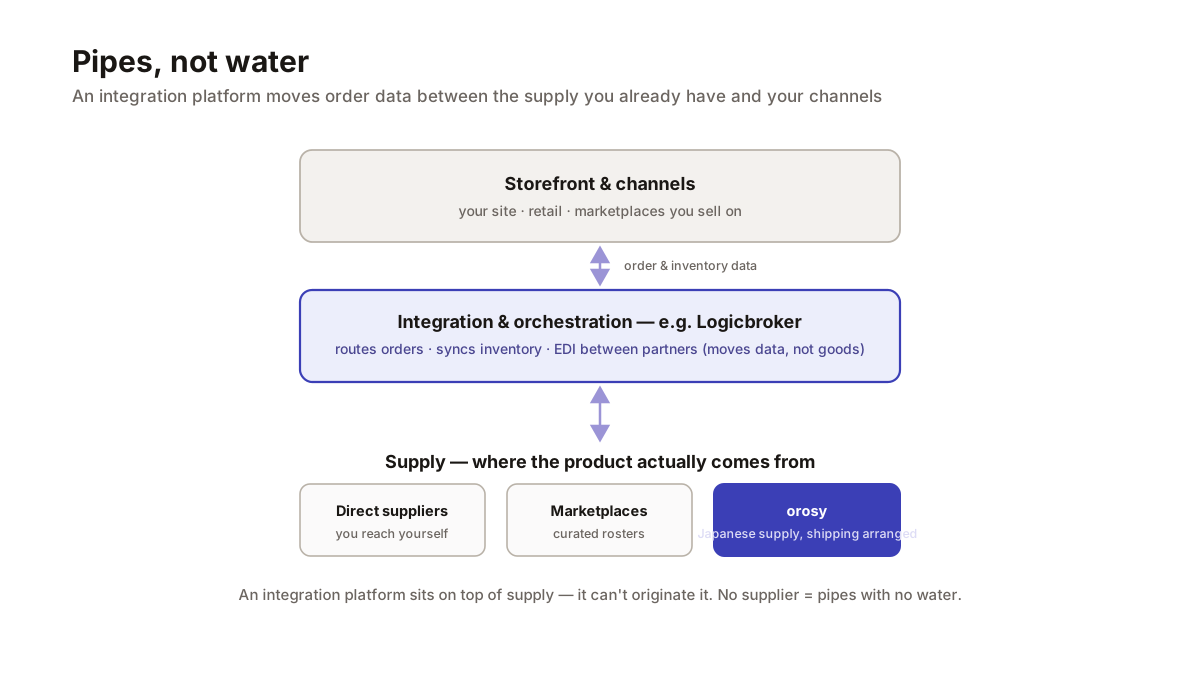
Logicbroker is the integration layer — it moves data between the supply you already have and your channels. It doesn't originate supply.
What this means if you want Japanese product
If the goal is Japanese product on your shelf, an integration platform doesn't move you forward on its own, because the unsolved problem is in the supply layer:
- You still need a source. Logicbroker can connect a Japanese supplier into your systems — but only once you have one. Finding, qualifying, and contracting that supplier, and handling customs and freight, is the actual work, and it's upstream of integration.
- Once you have a source, integration becomes useful. If you're a large retailer with EDI workflows, a platform like Logicbroker can absolutely be where you operationalize a Japanese supplier you've secured. That's the complementary case, not a competing one.
So the real comparison for Japanese product is in the supply layer: source direct from Japan yourself, or use a handled model that reaches Japan's breadth for you.
Integration layer vs. supply source: where each fits
| Logicbroker (integration) | Source direct from Japan | Handled sourcing model | |
|---|---|---|---|
| What it is | Order/EDI orchestration between partners | You reaching Japanese suppliers yourself | A supply source that has contracted Japanese suppliers and arranges shipping |
| Provides products? | No — connects partners you bring | Yes — Japan's supply base, if you can reach it | Yes — a broad breadth of Japanese supply |
| Who arranges shipping? | No — it moves data, not goods | No — entirely yours as importer | orosy arranges shipping; duties & clearance stay yours |
| Where it sits | Integration / orchestration layer | Supply layer | Supply layer |
| Best used for | Operationalizing partners at scale (EDI, routing) | High-volume buyers with import staff & time | Buyers who want Japan's breadth, handled |
| Works with the others? | Yes — can sit on top of any supply source | Can be integrated via a platform like Logicbroker | Can be integrated via a platform like Logicbroker |
The honest takeaway: Logicbroker isn't an alternative to a Japanese supply source — it's a different layer that can sit on top of one. If you only have an integration platform and no Japanese supplier, you have pipes and no water.
When Logicbroker is the right call (and we mean it)
For the right buyer, Logicbroker is an excellent choice. Reach for it when:
- You run a drop-ship or marketplace program at scale. If you're onboarding and orchestrating many trading partners, that's exactly what it's built for.
- You need EDI and order automation. Real-time inventory, ASNs, invoice flows across partners — its core competency.
- You already have your suppliers. Integration shines once the supply relationships exist; it's there to operationalize them.
Reach for a supply source (direct or handled) instead — or first — when the unsolved problem is finding and importing the product itself, which is true for almost anyone trying to add Japanese product.
Where orosy fits
orosy sits in the supply layer, not the integration layer — and it's built around Japanese supply specifically. The name comes from the Japanese word orosu (卸す), "to wholesale."
orosy draws on a Japanese marketplace with 5,000+ brands and suppliers and 20,000+ buyers, with the company founded in 2018 and now an equity-method affiliate of giftee Inc. (Tokyo Stock Exchange Prime: 4449). What you can order depends on where the goods are going: the catalog available for shipping to the US is stationery, over 50,000 products (measured 2026-10-23), while the catalog for delivery inside Japan is larger, about 200,000 products. You pick what fits your shelf, orosy carries the negotiations and account opening with each supplier, and orosy arranges the international shipping to your country. You do not need a forwarder or a receiving point in Japan. Before you order, the cart shows a reference figure for international shipping, for your information only. The actual shipping cost is calculated later and billed to you, and it can differ from that figure.
Crucially, orosy and an integration platform aren't competitors. A large retailer could secure Japanese supply through orosy and then operationalize it inside a platform like Logicbroker. orosy answers "where does the Japanese product come from, who holds the supplier relationships, and who arranges the shipping"; an integration layer answers "how does the order data flow once I have a supplier." Different questions, different layers.
FAQ
Can I source Japanese products through Logicbroker?
No. Logicbroker is an integration and order-orchestration platform — it connects a retailer to trading partners it already has and automates EDI, order routing, and inventory sync. It doesn't carry a catalog of suppliers to buy from, so there's no Japanese supply to source inside it. You'd secure a Japanese source separately and could then integrate it.
Is Logicbroker a marketplace or a supplier?
Neither. It's the integration layer between a retailer and its suppliers or marketplace partners. It moves order, inventory, and shipment data; it doesn't sell products or hold a catalog. Marketplaces and suppliers are the supply layer; Logicbroker sits above them, orchestrating the data.
Is Logicbroker a good platform?
For its purpose, yes — it's a capable enterprise tool for running drop-ship and marketplace programs, with EDI support, fast partner onboarding, order automation, and annual pricing without per-order fees. The limitation for this article's reader is category, not quality: it's infrastructure, not a Japanese supply source.
Could I use orosy and Logicbroker together?
Yes — they're complementary. orosy is a supply source for Japanese product that carries the supplier relationships and arranges the shipping; an integration platform like Logicbroker operationalizes order and inventory data once you have a supplier. A large retailer could reasonably use both: orosy for the supply, Logicbroker for the order plumbing.
How is orosy different from Logicbroker?
They sit in different layers. orosy is a Japanese wholesale supply source drawing on 5,000+ brands and suppliers, and it carries the negotiation and account opening with each supplier, consolidates a multi-supplier order into one cart and one invoice, and arranges the international shipping. What you can order depends on where the goods are going: the catalog available for shipping to the US is stationery, over 50,000 products (measured 2026-10-23), while the catalog for delivery inside Japan is larger, about 200,000 products. Before you order, the cart shows a reference figure for international shipping, for your information only. The actual shipping cost is calculated later and billed to you, and it can differ from that figure. Customs clearance, import duties, and taxes at import are yours, and are not part of what orosy bills. Logicbroker is integration infrastructure that routes order data between partners you already have. One provides the product, the supplier relationships, and the shipping arrangement; the other moves the data.
Sources
- Logicbroker — platform overview (EDI, drop-ship, order orchestration, onboarding): https://logicbroker.com/
- Logicbroker on Microsoft Marketplace (Marketplace + Drop Ship for B2B & B2C): https://marketplace.microsoft.com/en-us/product/web-apps/logicbrokerinc.logicbroker?tab=overview
- Logicbroker — drop ship automation and managed EDI for retailers: https://www.logicbroker.com/for-retailers/for-retailers-old/
- Logicbroker on the Shopify App Store (marketplace/dropship strategy): https://apps.shopify.com/logicbroker