Quick answer: Sourcing Japanese food wholesale uses the same routes as any Japanese product, but two constraints reshape the decision. First, the product ages: the best-by date is printed in Japan and a meaningful share of it is spent in transit and clearance, so remaining dating belongs in your buying criteria alongside cost and case pack. Second, imported food carries FDA obligations that a teapot does not, and those obligations cost roughly the same whether a SKU sells a thousand cases a year or forty. That fixed cost per SKU is the real reason the Japanese food you can buy domestically is a short, safe list rather than the range Japan actually produces.
Key takeaways
- In food you are not buying a case price, you are buying remaining dating. The best-by clock starts at the factory in Japan and runs through booking, sailing, clearance, and trucking before the product reaches your shelf.
- Ambient, chilled, and frozen are three different businesses, not three options on a menu. Almost everything that travels well from Japan into US retail is shelf-stable, and that is a consequence of the cold chain, not of taste.
- Four obligations sit on top of ordinary customs on any imported food: prior notice, foreign facility registration, supplier verification, and US-compliant labeling. Every route pays them; the routes differ in who holds them.
- Those obligations are largely fixed per SKU, which is why domestic importers rationally stock proven high-rotation items and why the regional and seasonal long tail rarely reaches their catalogs.
- Most first orders go wrong on details that are settled before anyone talks about price: remaining dating on arrival, case and inner-pack structure, allergen wording, and lot coding.
What you are actually buying is remaining dating
A bag of rice crackers made outside Osaka carries a best-by date printed at the factory. Nothing about crossing the Pacific pauses that date. By the time a case has been ordered, consolidated, sailed, cleared, and trucked to your warehouse, a real share of the product's life is already behind it, and the remainder is what you bought. The case price was only ever half the transaction.
Buyers who come to Japanese food from durable categories tend to learn this on the second order rather than the first. Homeware forgives slow decisions: a ceramic bowl that sits in a warehouse for eleven months is still a ceramic bowl. A confection that sits for the same period is a markdown with a date attached. So the discipline the category demands is not really about Japan at all. It is ordinary perishable-goods discipline, applied to a supply line that is longer than the domestic ones you are used to.
Three practical consequences follow, and they are worth setting down before you look at a single supplier.
Remaining dating is a buying criterion, not a delivery detail. Ask what dating looks like on arrival, not what dating the product carries at manufacture. Those are different numbers and only one of them is yours.
Reorder cadence is set by the clock, not by your cash cycle. A durable-goods buyer reorders when stock runs low. A food buyer has to reorder early enough that the replacement arrives with enough life left to sell through at full price, which means the lead time and the dating interact. Build the buffer before a winner runs out, not after.
Slow movers are more expensive here than elsewhere. In a non-perishable category a slow SKU ties up cash. In food it ties up cash and then expires. That is why experienced food buyers concentrate on proven rotation and keep their experiments small and deliberate.
Ambient, chilled, and frozen are three different businesses
The second structural fact is temperature. Japanese food splits into three classes, and the step between them is much larger than it looks on a spec sheet, because each step adds equipment, cost, and a set of operators willing to handle it.
| Class | What it covers | How it travels from Japan | What it demands of you |
|---|---|---|---|
| Shelf-stable (ambient) | Snacks, confections, rice crackers, instant noodles, seasonings, teas, packaged staples | Consolidates easily and tolerates ocean transit; the class most general operators will handle | Ordinary warehousing; the constraint is dating, not equipment |
| Chilled | Fresh and refrigerated goods with short lives | Needs an unbroken cold chain and, in practice, air freight for anything with a short window | A specialist forwarder and a receiving operation that can hold temperature |
| Frozen | Frozen prepared foods, seafood, some confections | Reefer containers and cold storage on both ends | Cold-storage capacity, higher freight cost, and a distributor set up for frozen |
This is why the Japanese food you actually see in general US retail is overwhelmingly ambient. It is not that Japan makes fewer chilled products. It is that ambient goods can move through the same freight and warehousing infrastructure as everything else, and chilled and frozen cannot. If your assortment plan assumes frozen, you are not adding a category to an existing operation; you are choosing a different operation, with a narrower set of partners.
For a first move into Japanese food, ambient is the honest recommendation, and not as a compromise: the strongest part of the category for a US shelf is the packaged and confectionery range, which is shelf-stable to begin with.
The four obligations, and who is holding each one
Here is where food separates from every other Japanese category. Imported food sits under federal food-safety oversight that does not apply to a stapler. Four obligations matter to a buyer, and the useful question is never whether they apply, but who is carrying them on the route you chose.
| Obligation | What it covers | You buy from a US importer | You import directly |
|---|---|---|---|
| Prior notice | Advance notice to FDA of an incoming food shipment, separate from the customs entry | Filed upstream before the product reached the importer | Yours, on every shipment |
| Foreign facility registration | The Japanese facility that makes, processes, packs, or holds the food is registered with FDA | Settled before that SKU entered the importer's catalog | You confirm the maker's facility is registered and stays registered |
| Foreign supplier verification | The US importer's own program for verifying that foreign suppliers meet US safety standards | Held by the importer | Yours, as the importer |
| US labeling | English information, ingredient and allergen disclosure, nutrition presentation, net quantity | Resolved on the SKUs the importer chose to carry | Yours, and often means new artwork rather than a sticker |
This guide deliberately stops at naming them. Food-import compliance is detailed, it moves, and getting it wrong has consequences that a blog post cannot insure you against, so treat the table as a map of the questions rather than a procedure. Confirm how each obligation applies to your specific products and suppliers with a licensed customs broker or a regulatory advisor before you commit to a route. (FDA — Importing Food Products into the United States) Nothing here is legal or regulatory advice.
What the table is good for is a single insight that explains the shape of the whole category, and it is the next section.
Why the domestic catalog is short: the cost is per SKU, not per case
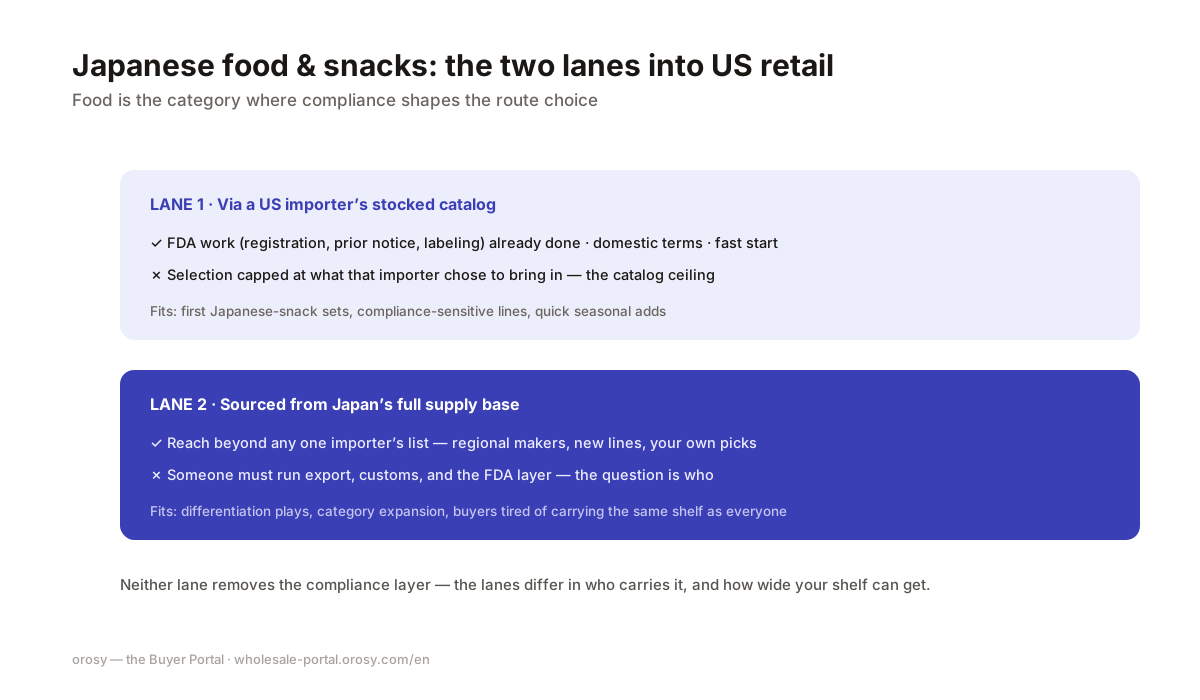
Neither lane removes the compliance layer — the lanes differ in who carries it and how wide your shelf can get.
Look again at the four obligations and notice what they have in common: almost none of the work scales with volume. Registering a facility, resolving label artwork, standing up verification records, and clearing a first entry cost about the same whether the SKU goes on to sell a thousand cases a year or forty. The freight scales. The duty scales. The compliance groundwork does not.
That is the whole explanation for a pattern buyers often read as timidity. A US importer specializing in Japanese food is making a rational calculation on every line it carries: the fixed cost of bringing a SKU into compliance has to be amortized over the volume that SKU will plausibly do. High-rotation, shelf-stable, nationally recognizable items clear that bar comfortably. A regional confectioner's seasonal box does not, however good it is, because the volume that would justify the groundwork is not there.
So the catalog you can buy from domestically is not a curated selection of the best Japanese food. It is a selection filtered by amortization. The proven movers are there because they are proven movers. The distinctive, regional, and seasonal products, which are exactly the ones that would differentiate your shelf from the grocery two blocks away, are missing for a reason that has nothing to do with quality and everything to do with per-SKU math.
That is also why the domestic-importer route is genuinely the right first move for many buyers, and why it stops being right later. Buying already-cleared inventory on domestic terms is the fastest way to learn whether Japanese snacks sell in your store, at no compliance cost to you. Once you know they sell, the ceiling appears: your Japanese section looks like everyone else's, because everyone else buys from the same short list.
The direct routes open the long tail and hand you all four obligations at once, on goods with a running clock. That is a heavy operation to stand up for a first test order, which is why so few buyers do it and why the tail stays untouched.
Questions to settle before the first case ships
Most first orders in this category go wrong on details that have nothing to do with price. These are the ones worth putting to a supplier, an importer, or a sourcing partner in writing, before you talk about cost.
- What is the remaining dating on arrival? — Not the shelf life at manufacture. Ask for the expected remaining life at your dock, and ask what minimum they will commit to. Many retail and distribution operations apply their own receiving rule on remaining life, and you want to know in advance whether the answer clears yours.
- How is the date printed, and in what format? — Japanese packaging commonly carries a year-month-day date in an order and format your receiving team may not read at a glance, and some products carry a best-by rather than a use-by. Settle how it is printed and how your team should interpret it before the pallet arrives, not while it is on the dock.
- What does the case and inner-pack structure look like? — Case count, inner packs, and unit presentation are set for the Japanese retail channel, and they may not match how you want to merchandise. This is also where the practical minimum lives: the real question is rarely "what is the MOQ" but "what is the smallest sensible unit I can buy and still sell through before the date."
- What is the allergen and ingredient statement, in English? — Ingredient and allergen disclosure has to meet US requirements, and a translated marketing description is not the same document as a compliant statement. Ask who is producing it and who has reviewed it. This is a question for your regulatory advisor as much as for the supplier.
- How is the lot coded, and could you trace it back? — If a product has to be traced or withdrawn, lot coding is what makes that possible in hours rather than days. Ask what the coding scheme is and confirm you can map a case on your shelf back to a production lot.
None of these are exotic. They are the ordinary receiving questions of any food operation, and they matter more here only because the supply line is long enough that a misunderstanding takes weeks to surface rather than a day.
Duties and freight, briefly
Import duties and international freight apply to Japanese food as to any other category, and neither disappears on any route. Buy already-cleared inventory from a domestic importer and both are already inside the price, folded into a markup you cannot see itemized. Import directly and you carry them yourself, line by line.
Food classifications are more granular than general merchandise, so the rate for a given product comes down to its specific HTS classification rather than to a category-wide figure. You can look your own heading up in the Harmonized Tariff Schedule, and the 2025 US–Japan framework that sets the rate on top of it is summarized by the Congressional Research Service. Confirm the treatment of your actual products with a licensed customs broker. The mechanics are covered properly in our companion guide.
→ Importing Japanese products: customs, duties, and logistics
One point specific to this category: freight timing and shelf life are the same decision. In durable goods you pick a freight mode on cost. In food, choosing the slower mode spends dating you may need later, and choosing the faster one buys life at a price per unit. Model both together or the model is wrong.
orosy — the Buyer Portal
orosy was built on a marketplace in Japan, so the part of this problem it knows best is the supply side: how much of Japan's food and confectionery range never reaches a catalog that a US buyer can order from, and why. It is not for want of good product. It is the per-SKU math in the section above, applied over and over until the tail is invisible from the outside.
The name comes from the Japanese word orosu (卸す), "to wholesale." Founded in 2018, orosy connects US buyers to a wide breadth of Japanese supply, with 5,000+ Japanese brands and suppliers, about 200,000 products, and 20,000+ buyers on the marketplace. orosy carries the individual negotiations and account opening with each supplier, so a basket spanning several makers is one cart and one invoice, and orosy arranges the international shipping to your country. You do not need a forwarder or a receiving point in Japan.
Be precise about which part of the work that moves and which part stays with you. Before you order, the cart shows a reference figure for international shipping, for your information only. The actual shipping cost is calculated later and billed to you, and it can differ from that figure. Customs clearance in your country, import duties, and taxes at import are your responsibility. They are not part of the cost billed by orosy, and the food-safety obligations above remain yours as the importer, to confirm with your own regulatory advisor. What widens is the shelf you choose from — the regional and seasonal products that a per-SKU amortization test would never let through. Delivery to a receiving point inside Japan also remains available.
FAQ
What is the fastest way for a US retailer to start carrying Japanese snacks?
Buy already-cleared inventory from a US-based importer that specializes in Japanese food, or order through an in-region B2B marketplace. The compliance groundwork was done before the product reached them, so you buy on domestic terms with no regulatory work of your own, and you find out quickly whether the category sells in your store. The limit shows up later: you are choosing from the same short list of proven movers that every other retailer is choosing from.
How much shelf life should I expect on Japanese food when it arrives?
Ask rather than assume, because it depends on the product, the freight mode, and how long the goods sat before consolidation. The important move is to make remaining dating on arrival an explicit term rather than a surprise: ask what minimum remaining life the seller will commit to at your dock, and check it against your own receiving rules before you order.
Which FDA obligations apply when I import Japanese food directly?
Four that a buyer should know by name: prior notice of the incoming shipment, registration of the foreign facility that makes or holds the food, a foreign supplier verification program, and US-compliant labeling covering English information, ingredients, and allergens. If you buy from a domestic importer, that importer carried them. If you import directly, they are yours. How each applies depends on your products and suppliers, so confirm the specifics with a licensed customs broker or regulatory advisor. This is not legal or regulatory advice.
Why is the Japanese food I can buy in the US so much narrower than what Japan makes?
Because the compliance and clearing groundwork costs roughly the same per SKU regardless of how much that SKU sells. An importer can justify it for a high-rotation, shelf-stable item that will move steadily. The same cost against a regional confectioner's seasonal product does not pay for itself, so it never enters the catalog. What you see domestically is filtered by that amortization test, not by what Japan produces or how good it is.
Can I import chilled or frozen Japanese food the way I would snacks?
Not on the same operation. Chilled and frozen goods need an unbroken cold chain, cold storage on both ends, and forwarders and distributors equipped for it: a different set of partners and a materially different cost base. Shelf-stable goods move through ordinary freight and warehousing, which is why almost all the Japanese food in general US retail is ambient. Treat frozen as a separate business decision rather than an extension of an ambient assortment.
Sources
- US Food and Drug Administration — Importing Food Products into the United States (prior notice, facility registration, supplier verification, labeling): https://www.fda.gov/food/importing-food-products-united-states
- Harmonized Tariff Schedule of the United States, US International Trade Commission (classification lookup): https://hts.usitc.gov
- US Tariffs and the 2025 US–Japan Framework Agreement, Congressional Research Service: https://www.congress.gov/crs-product/IN12608